Chatbot vs. AI Agent vs. Conversational AI: A Field Guide for Small Business Owners
You're not confused because you're not technical. You're confused because vendors profit from it. A buyer's map of the five generations of business AI.
You're not confused because you're not technical. You're confused because the vendors profit from it. Here's the map they don't hand you.
TL;DR
- Most "AI" sold to small businesses is one of five generations of technology — knowing which (and which blend) is how you know what you're buying.
- Three questions cut through any pitch: where you're losing customers, how autonomous it actually needs to be, and what's the cost of being wrong.
- The terminology will keep changing — anchor to the capability curve, the job to be done, and your integration graph.
- Buying principle: optimize for graceful obsolescence — pick the vendor most likely to carry you to 2028, not today's best.
The confusion is manufactured
In the last three months, a small business owner I know was pitched by five different companies selling roughly the same thing.
One called it a chatbot. One called it conversational AI. One called it an AI agent. One called it an AI employee. The fifth called it an AI receptionist. Five names, five sales decks, five pricing models that didn't line up — and underneath at least three of them, the same core technology in different clothes.
She did what any reasonable person does when five confident strangers use five different words for the same thing. She froze, bought nothing, and went back to missing calls she'll never get back.
She froze, bought nothing, and went back to missing calls she'll never get back.
She didn't freeze because she isn't smart enough to understand AI. She froze because the people selling it have no incentive to make it clear. Vague categories and futuristic names work in the vendor's favor: the more confused you are, the easier you are to sell to, and the harder it is to compare one quote to the next.
This piece is the map they don't hand you. By the end you'll have a simple model for the five kinds of business AI, the question that exposes each label on a sales call, three questions that cut through any pitch, and a way of buying that survives the next time the industry renames everything — which it will.
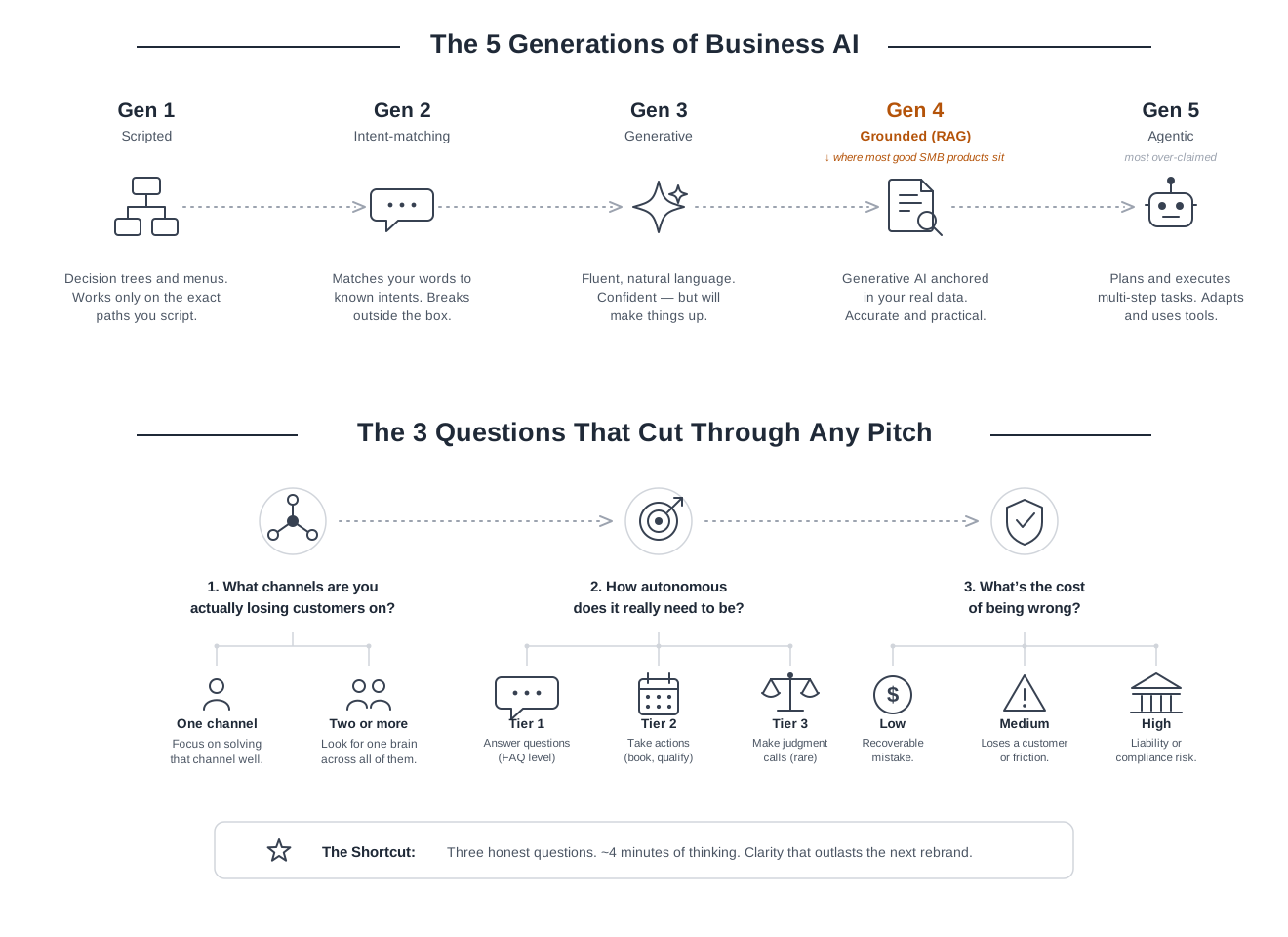
The five generations of business AI
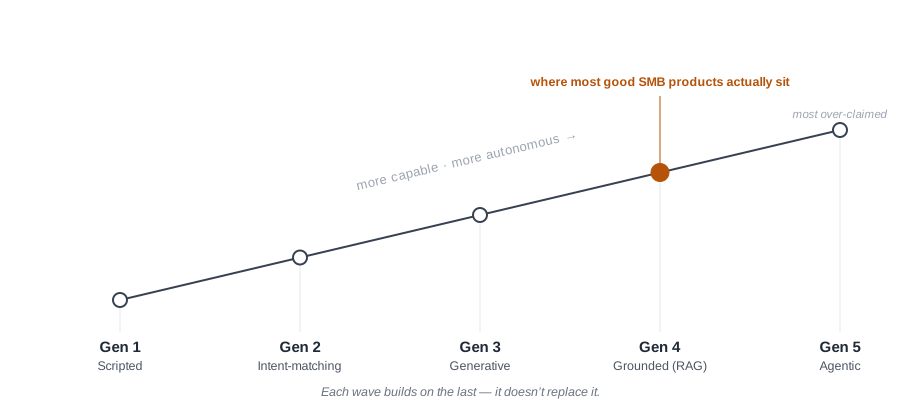
Business AI didn't arrive all at once. It came in waves, and each wave built on the last instead of replacing it. That matters, because most products on the market are blends of these waves — and the blend is where the marketing hides.
Think of phones: smartphones didn't kill landlines, and plenty of businesses still run a landline behind a modern system. AI is the same. The older generations are still out there, still being sold, often with a fresh coat of paint.
One caveat. This isn't an official classification; no standards body ratified "Generation 4." It's a practical buyer's framework — a way to see what's under the hood regardless of the label on the box. A map, not a law of physics.
Generation 1: Scripted
What it is. The decision tree. "Press 1 for billing." On a website, the bot with four buttons that panics if you type anything else.
What it can do. Predictable paths, fast and cheap. Route a call, answer a fixed menu.
What it can't. Anything off-script. Step an inch off the path and it breaks.
Who it's right for. Genuinely simple, repetitive routing — and not much else.
The tell. If the demo only works when you say exactly the right thing, it's Generation 1, whatever it's called.
Generation 2: Intent-matching
What it is. The first "smart" chatbots, roughly 2016–2020 — Dialogflow, Lex, early Watson. It matches your words to a list of predefined intents.
What it can do. Handle variations of expected questions. "When do you close?" and "are you open late?" map to the same answer.
What it can't. Cope outside its trained intents — flexible inside the box, useless outside it. This is the generation behind most of the "I hate chatbots" feeling.
Who it's right for. Far from dead: banks, airlines, telecoms, and regulated call flows still run on it, because predictability beats flexibility there. For most new SMB deployments, it's been overtaken.
The tell. It handles rephrasings but loops back to "I didn't quite get that" on anything genuinely novel.
Generation 3: Generative
What it is. The ChatGPT moment, 2022 on. A large language model that writes fluent answers instead of retrieving canned ones.
What it can do. Hold a real conversation, understand nuance, sound human.
What it can't. Stick to the facts about your business on its own. Raw, it'll confidently invent your hours, prices, or a policy you never had. Fluency isn't accuracy.
Who it's right for. Almost no small business should point raw Generation 3 at customers. It needs a leash — which is Generation 4.
The tell. A smooth talker that occasionally says something untrue about your business. If a demo dazzles but you can't see where it gets its facts, be careful.
Generation 4: Grounded generative (RAG)
What it is. Generation 3's fluency, anchored to your real information. The technical name is RAG; the idea is simple — before answering, it looks up the actual facts (your hours, services, documents) and answers from those.
What it can do. Speak naturally and accurately. With a few integrations, book appointments and capture leads.
What it can't. Reason through complicated multi-step problems, or recover gracefully when things get strange. Grounded, not clever.
Who it's right for. The sweet spot for most small businesses today: accurate, natural, affordable, and good enough for the vast majority of conversations.
The tell. The one to look for. Most genuinely good SMB products are Generation 4 — even the ones marketed as something fancier.
Generation 5: Agentic
What it is. The frontier, 2024 on. The clean definition: a system that independently plans and carries out a multi-step task, picking its own tools and adjusting when something fails. Working a goal, not just answering a question.
What it can do. Complex, multi-step work with judgment. Chain actions, adapt mid-task.
What it can't. Be cheap or fully mature yet. Real agentic capability is expensive and still being figured out, even by the biggest labs.
Who it's right for. Specific high-complexity workflows — and businesses that actually have them. Most small businesses don't, and shouldn't pay for capability they'll never use.
The tell. The most over-claimed word in the market. An "agent" at a small-business price is almost certainly Generation 4 with a few tools attached — fine, as long as you know that's what you're buying.
The thing to take away
New generations layer; they don't replace. The product you're sold is rarely one clean generation — it's a blend, maybe a Generation 4 brain with Generation 1 fallback rules and a Generation 5 word on the box. Knowing the blend is how you know what you're buying.
And the lines move. The gap between Generation 4 and 5 is already narrowing; within a year or two, "grounded chatbot with tools" and "agent" may stop being a useful distinction. That's fine — the borders aren't the point. Today, while you're the one being sold to, knowing roughly where a product sits tells you what you're paying for.
The decoder ring
Here's how the words vendors use map onto the five generations — and the one question that cuts through each label on a live call. Keep this open on your next demo.
| Term | What it usually is | The question to ask |
|---|---|---|
| Chatbot | Anything from a primitive script to a capable Gen-4 system; the word only tells you it's text. | Does it answer from my actual business information, or from a fixed script? |
| Conversational AI | A fancier umbrella term, usually Gen 3–4, often with voice. Sounds more advanced than "chatbot." Frequently isn't. | What can this do that a good chatbot can't? |
| AI agent | Should mean Gen 5. In small-business sales, usually Gen 4 with one or two integrations. The most inflated word in the category. | What specific actions can it take on its own, without a human stepping in? |
| AI assistant / copilot | Typically Gen 4, built to help a human rather than replace them. | Does it act on its own, or only suggest, while a person stays in control? |
| AI employee / AI receptionist | Describes the job, not the technology. The tech underneath varies enormously. | Forget the name — walk me through exactly what happens when a customer calls. |
| RAG | Not a product, a technique: it grounds the AI in your real information so it stops making things up. | How does it know facts about my business, and what stops it from inventing answers? |
| Fine-tuning | Retraining the model on your data. Different from RAG, and rarely necessary for a small business. | Why do I need this instead of just feeding it my information? |
| Self-learning | At small-business prices, almost always means "you can retrain it manually." A human in a loop, not an AI improving on its own. | Does it improve on its own, or does someone have to retrain it — and who? |
| Voice AI vs. Chat AI | Often sold as separate products by separate companies. The plumbing genuinely differs; the knowledge behind it shouldn't. | Is this one agent across phone and chat, or two products with two setups and two bills? |
That covers their product. Before any vendor call, though, three questions about your own business matter more.
The three questions that cut through any pitch
You could spend a weekend reading about RAG and agentic frameworks. Or you could ask three questions and land somewhere better than most vendors will take you in an hour.
Question 1: What channels are you actually losing customers on?
Not where customers reach you — where you lose them. For most small businesses that's two or three channels, not one: the dentist loses patients to voicemail during procedures and Instagram DMs that sit for days; the plumber misses calls on the job and the website chat at 9pm. Most products solve only one — voice vendors do the phone, chat vendors do the website — each with a separate bill and a separate brain that doesn't know what the other said. If you're losing customers in more than one place, knowing that up front changes the whole answer.
Question 2: How autonomous does it really need to be?
Three tiers, and vendors will push the top one regardless of what you need. Tier 1 — answer questions (hours, services, insurance); a grounded chatbot does this cheaply. Tier 2 — take actions: book, qualify, update the CRM. This is where most small-business value lives, and it needs real integrations. Tier 3 — make judgment calls: triage an urgency, decide a custom price, recover a conversation going sideways. Expensive, still maturing, rarely necessary. Pay for the tier you'll use; a Tier 3 product running a Tier 1 job is an expensive way to answer "what are your hours?"
Question 3: What's the cost of being wrong?
A bot that misquotes your hours costs a phone call. One that books the wrong appointment costs a customer. One that mishandles a medical intake or a legal question costs something harder to price. Match the technology — and the spend — to the failure cost, not the marketing copy. A restaurant can shrug off the occasional reservation slip; a law firm running first intake can't. And in regulated work, "wrong" means liability, and you may have to prove later what the AI said and why — so data handling, consent, and a record of its conversations are part of the failure cost, not a feature to skim.
The shortcut
Three questions, four minutes of honest thinking — more clarity than any demo, and a filter that holds no matter what the categories get renamed to next year.
Here's what those questions tend to produce by business type — a worked example, not a prescription:
| Business type | Channels that matter most | Autonomy you actually need | What "wrong" costs |
|---|---|---|---|
| Dental / medical | Phone + website chat | Tier 2 — book, qualify, route | A lost patient; insurance and clinical accuracy matter |
| Law firm | Phone + chat intake, human-supervised | Tier 2, edging toward 3 | High — confidentiality, liability, a record you can defend |
| Home services (HVAC, plumbing) | Phone, after-hours and overflow | Tier 2 — capture, dispatch, text the details | A lost job; usually recoverable with a callback |
| Restaurant | Phone + SMS, dinner-rush overflow | Tier 1–2 — reservations and hours | Low — a missed cover, recoverable |
Notice the pattern: almost nobody lands on Tier 3, and almost everybody needs more than one channel. That gap — between what gets sold and what gets used — is where most of the overpaying happens.
The uncomfortable truths
Everything so far was the map. Here's what it usually leaves out — true, decision-relevant, and not in any vendor's interest to mention.
Take a real one. A friend works the front desk at a clinic with several doctors. They were pitched "AI" from every direction — some built into their practice-management software, some from outside — all promising to take over the inbox and referral work.
They picked one, deployed it, and it got roughly half of those referral and inbox tasks wrong. Her job didn't shrink; it doubled, because every mistake had to be caught and redone by hand.
The vendor's line never changed: it'll learn from the corrections and improve. She logged every error and reported it. It never got better, the bill kept climbing, and after three or four months of doubled work and apologizing to the doctors, they dropped the vendor.
That clinic now believes AI is a scam and won't look at a legitimate solution. The overpromise didn't just cost them money — it poisoned the well for everyone who comes after.
And notice why it failed: not because the AI was fake, but because of the boring stuff. A knowledge base nobody kept current, a calendar integration that quietly broke, no path to hand a hard case to a human, no one inside the business owning it after the salesperson left.
The model is usually the easy part. The discipline around it is the hard part, and it's the part nobody demos.
None of what follows is a vendor secret — it's just what someone should have told that clinic before they signed.
"AI agent" has become nearly meaningless
Two years ago it meant a system that plans across steps, picks its own tools, and recovers when something fails. Now it's a marketing word — most "agents" sold to small businesses are grounded chatbots with a couple of integrations. No insult; a chatbot that books appointments is useful. But you're often paying agent prices for chatbot work.
"Self-learning" is usually a human in a loop
Ask what it means and it's almost always: you can review transcripts and retrain it by hand. Useful, but not automatic. Fully autonomous, self-improving systems stay rare and immature at small-business prices; a vendor implying otherwise is describing a roadmap.
The voice/chat split runs deeper than it should
Voice and chat are genuinely different engineering problems — latency, people talking over each other, speech recognition, carrier integration. Separate plumbing makes sense. Separate brains don't. There's no good reason your phone AI and your website AI should run on disconnected knowledge — a different memory of your hours and policies depending on how a customer happened to reach you. That fragmentation isn't a law of nature; it's vendor history. Telephony companies built voice tools, chatbot companies built chat tools, and you inherited their org chart as your buying problem.
A friend runs a growing pest-control business on the side — too small for a full-time receptionist, drowning in repetitive calls. He added a website chatbot; it helped, but he still missed calls on the job, so he bought a separate AI phone receptionist from a known brand at a steep monthly fee. He now pays two vendors and is locked into both — not because he needed two products, but because no pitch told him voice and chat could be one system. The confusion didn't make him freeze. It made him buy twice.
In fairness: unified isn't automatically better. In heavily regulated or unusual workflows, a specialized tool can beat a generalist. Integration isn't a virtue in itself. But for most small businesses, fragmentation costs more in daily friction than the specialization is worth.
You're probably quoted at last year's prices
Model and inference costs have dropped sharply; plenty of incumbents haven't passed it on. When you compare quotes, you're partly measuring how recently each vendor was forced to be honest about cost.
The real lock-in is your knowledge base, not the AI
The bot is replaceable; what isn't is everything around it — your tuned answers, your integrations, the history of every conversation. That's the asset, and it's the vendor's moat unless you ask one question up front: if I leave, what do I keep?
The pattern underneath
The root is the same each time: confusion is profitable. None of it survives a direct question — so ask direct questions.
The half-life problem
Here's the catch with everything above: a lot of the vocabulary has a shelf life of about two years. "AI agent," "conversational AI," "copilot" — picture how they'll sound in 2028, about like "expert system" sounds now. "Chatbot" was cutting-edge in 2017; today it's the word for the annoying thing on a website. The names aren't stable ground. So what do you anchor to?
Three things hold their shape while the words around them keep shifting:
- The capability curve. Cost per interaction keeps falling fast, the pause before an answer keeps shrinking, and voice quality has already crossed the line where most callers can't tell. You don't need to know what the tech will be called next year — only that it'll be cheaper and better than today's quote. Buy in a way that lets you benefit.
- The job to be done. Answering customers, capturing leads, booking work — unchanged since you opened, and unchanged when the category gets renamed.
- The integration graph. Your calendar, CRM, phone system, and the record of every conversation. The connections are the durable asset; the bot on top is replaceable by design.
Which leaves one buying principle: optimize for graceful obsolescence. Don't pick the best product for today; pick the vendor most likely to carry you to the 2028 version without making you start over. Ask how they handle model upgrades. Ask what happens to your data if you leave. Ask whether their pricing tracks the falling cost of the technology, or whether you'll still pay today's rate in two years while their costs drop.
That last one applies to us too — I build Zalena, and "are we still charging what this actually costs to run?" is a question I'd rather you ask us than not. Put every vendor, including mine, through the same questions and the same uncomfortable truths. The ones worth your money won't flinch.
The terminology will keep changing. The questions won't. Learn the questions, and you'll outlast every renaming.
I'm the founder of Datalya, an AI consulting firm, and the creator of Zalena, an AI voice and chat platform built for small businesses.
Get new posts in your inbox
Notes on AI assistants, customer experience, and what's working for the small businesses building on Zalena. No spam.