The $126,000 line item that doesn't exist
The average small business loses $126,000 a year to missed calls and unanswered messages. Here's why the loss stays invisible — and what it takes to see it.
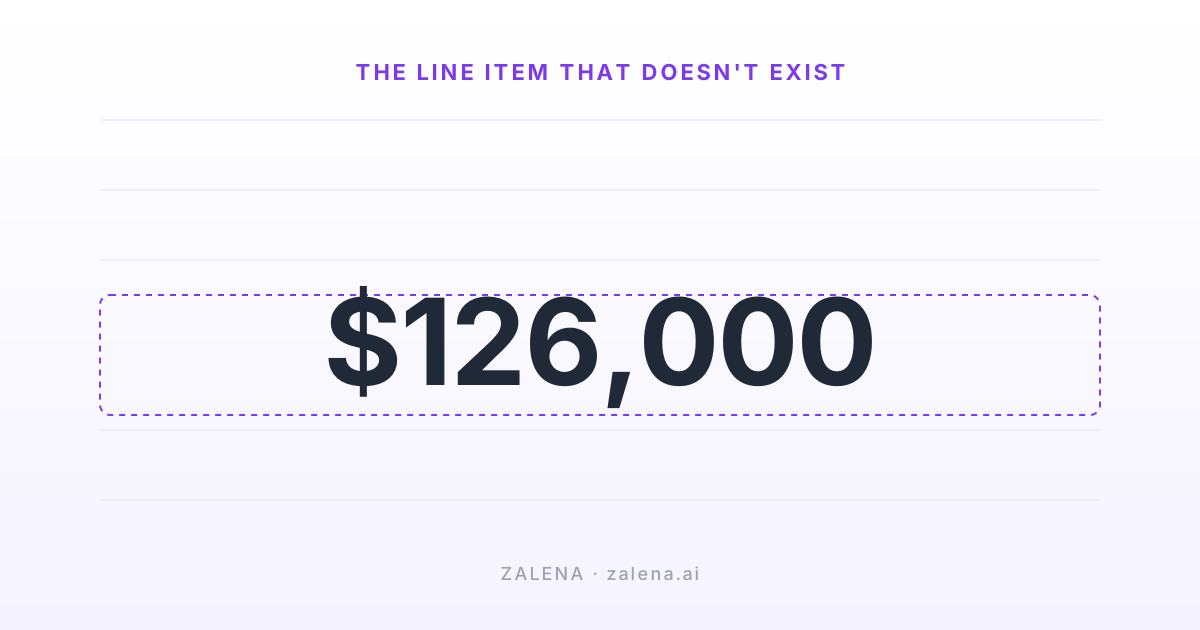
The average small business loses around $126,000 a year to missed calls, according to research aggregated by Aira from sources including 411 Locals, PATLive, and AMBS Call Center. It doesn't show up on any P&L.
There's no row in QuickBooks for callers who hung up. No GL code for the website visitor who closed the tab and went to a competitor. No expense category for the contact form that took 36 hours to answer. The loss is real, recurring, and measurable, but it sits entirely outside the systems most owners use to run their business. This post is about how big that loss actually is, why it stays invisible, and what it takes to finally see it.
Where the $126K comes from
The number isn't a guess. It comes from straightforward math applied to publicly available benchmarks.
Start with the miss rate. A study by 411 Locals tracked 85 businesses across 58 industries and found that only 37.8% of inbound calls were answered by a live person. The remaining 62% went to voicemail or got no response at all.
Add the non-callback rate. According to PATLive, 85% of callers who don't reach a live person never call back. Most of them don't even leave a voicemail — about 80% hang up rather than record one. And 78% of customers buy from the first business that responds to their inquiry, which means the call that didn't get through is usually a call that closed somewhere else.
Multiply those rates by a per-call value and the math does the rest. The standard formula used across the industry is:
Monthly missed calls × Average customer value × 12 × 0.85 = annual revenue loss.
A small service business missing 25 calls a month at a $400 average customer value loses about $102,000 a year. A slightly busier business missing 40 calls a month at the same value loses $163,000. The widely-cited $126,000 figure is the middle of that range — and it's the floor for businesses big enough to track this. For most SMBs, who don't track it at all, it's almost certainly higher.
These benchmarks vary by industry, geography, and call intent, but even conservative assumptions produce meaningful loss. And the call data understates the real number, because every modern small business has a second front door — the website chat box, the contact form, the inquiry that comes in at 11pm and doesn't get answered until Thursday. Those losses don't show up in any phone log either.
Why this stays invisible
Three reasons explain why owners can spend years bleeding revenue through this channel without ever seeing the line item.
The first is that there is no accounting category for it. A missed call is the absence of a transaction, not a failed one. The marketing dollars that drove the caller to the business are booked. The call itself, and its outcome, are not. The same is true for a contact form that goes unanswered or a chat session that ends without resolution. Lost revenue from a conversation that never happened doesn't reconcile against anything.
The second is that there's no callback signal. With voice, 80% of callers who reach voicemail never leave a message. The owner literally never knows they were tried. The same blind spot exists on the web side, in a different form — a visitor who closed the tab and clicked the next Google result leaves no trace at all. The visitor counter doesn't tell anyone they wanted to ask a question. In both channels, the lost prospect is silent by default.
The third is that marketing dollars hide the leak. A business spending $3,500 a month on Google Ads, with 62% of resulting calls unanswered and a meaningful share of form submissions answered too late, is paying full cost for a fraction of the value. The customer acquisition math looks fine on a dashboard while the actual conversion engine is leaking through the floor. The leak gets noticed only when ad spend goes up and bookings don't follow.
In most SMB setups, this data is fragmented across a phone system, a CRM, a website analytics tool, and the owner's memory. Tools like CallRail and HubSpot capture parts of it. None of them stitch the whole picture together by default. Most owners aren't ignoring missed conversations — they're looking at five different tools that each show one slice of the loss, and never the total.
Where the loss is sharpest
The $126K average smooths over enormous variation between industries. The verticals where voice and chat AI generate the highest measurable returns aren't the ones with the most calls — they're the ones where the first contact is the highest-stakes contact.
In dental practices, 20-38% of calls go missed, mostly because front desk staff are checking in another patient when the phone rings. Each missed new-patient call represents about $850 in lifetime patient value, according to Patient Prism data. A practice missing 10 new-patient calls a month loses over $100,000 a year on this channel alone. Dental websites also see meaningful after-hours traffic — patients comparing options at 9pm on a Sunday — and a static contact form converts at a fraction of the rate of an immediate response.
Law firms miss approximately 35% of incoming calls, according to Clio's Legal Trends Report. The economics are worse per call: a single missed inquiry in personal injury or family law can represent $5,000 or more in lost fees. Legal matters are by definition acute. A caller who just got injured, just got served, or just got arrested doesn't wait for a callback. They call the next firm on the list. A growing share of those inquiries now start as chat — someone Googling "personal injury lawyer near me" at 11pm wants to talk to something, not fill out a form and wait until morning.
Home service businesses miss around 27% of inbound calls (Invoca), with each missed call worth approximately $1,200 in immediate revenue — and the miss rate spikes during peak demand. A burst pipe in winter or a failed AC in summer is exactly when a contractor can't pick up, and exactly when the caller is least patient.
Veterinary practices have a similar dynamic to dental, but with a sharper after-hours problem. Pet owners calling about a sick animal at 8pm need a real answer about whether to drive to the emergency clinic or wait until morning. A voicemail is the wrong answer at that moment, and the practice that fails to provide one tends to lose the client permanently.
The pattern across all four verticals is the same: the value of an instant response isn't proportional to the volume of inquiries. It's proportional to the stakes of the first contact — whether that contact is a phone call, a chat message, or a form submission.
What this looks like in practice: Geek Square
Geek Square is a Toronto-based computer repair business, and one of Zalena AI's earliest chat deployments. Before the chat widget went live, the website had the standard SMB setup: a contact form, a generic email address, and a phone line that rolled to voicemail outside business hours. Customers with a broken laptop on a Saturday evening either filled out a form and hoped for a Monday reply, or moved on to the next shop on Google.
Two patterns showed up in the deployment data quickly.
About 30% of chat conversations come in outside business hours. That's nearly a third of all inbound conversations that, before the widget, would have been a contact form submission with a 36-hour response time at best — or no submission at all. Computer repair, like most home services, is a category where the customer's pain is acute. They want to know if their hard drive is recoverable, what it costs, and how soon you can look at it. They don't want to wait until Monday.
The chat widget converts roughly 4-5 of those weekly conversations into qualified bookings, with full contact information, the device details, and a transcript that the team reviews before the customer arrives. The response is instant, the lead is scored, and the team's first interaction with the customer is on a job that's already been triaged. None of these conversations existed in any system before — no row in the CRM, no entry in the call log, no line item anywhere.
This is what the $126K problem actually looks like in a single small business. Not a dramatic catastrophe. Just a steady, weekly recovery of conversations that were previously invisible.
The reframe: making the invisible visible
The default pitch for AI assistants is that they answer when the team can't. That's true, but it undersells what the technology actually does.
The real value is that every inbound interaction gets logged, structured, and searchable. For the first time, an SMB owner can see exactly how many calls came in last Tuesday between 6pm and 9pm, what those calls were about, how many ended in a booking, and what objections came up. They can see how many website visitors started a chat, what they asked, and at what point the conversation ended without a resolution. They can see the question pattern by season, by day of week, by hour.
This is the data SMBs have never had access to. It required a person to answer every call and every chat and write everything down — which no SMB has ever done at scale.
Voice and chat aren't substitutes for each other. They're two halves of the same dataset. The customer who calls today is often the same customer who chatted yesterday or filled out a form last week. Most small businesses have no way to know this. Each channel is a black box, and the connections between them are invisible.
When the conversations get captured, the accounting line item that didn't exist starts existing. Once it exists, it can be managed.
Voice AI makes the loss visible for the first time. Chat AI does the same for the conversations that started somewhere other than the phone. Together they cover the full inbound surface.
What to actually do about it
For owners who want to act on this without buying anything, four steps come first.
Measure the current miss rate. Most VoIP systems already log call answer rates. Pull the last 90 days. The number is almost always higher than expected. For chat, check whether the website widget logs sessions that end without resolution — most don't, by default, which is itself the problem.
Calculate the per-conversation value honestly. Use lifetime customer value, not first-transaction value. A missed dental patient isn't an $850 loss, it's a $7,500 loss. A missed legal inquiry isn't a $5,000 loss, it's a $5,000 loss plus the referrals that prospect would have generated.
Look at the time-of-day distribution for both channels. Calls peak at lunch, after 5pm, and on Mondays. Web traffic skews even more heavily toward evenings and weekends. If the team is structurally unavailable during those windows, no amount of training fixes it.
A caveat worth saying out loud: not every missed call is recoverable revenue. Some are price shoppers who would never have closed. Some are misdials. Some are existing customers calling about something that didn't need a same-day response. But enough of them are high-intent first-time inquiries that the economics still work — and the only way to know the actual ratio in a given business is to start capturing the conversations.
Decide the threshold. If the combined miss-cost across calls and web inquiries is below $20,000 a year, this isn't the highest-priority operational fix. If it's above $50,000 — and for most SMBs that hit either threshold, it usually is — then it almost certainly is.
The point isn't to install a tool. The point is to start seeing a number that's been there all along.
Zalena AI builds voice and chat assistants for the small businesses where missed conversations cost the most — dental practices, law firms, vet clinics, home services. Built in Ottawa, deployed across North America. If you want a rough estimate of what your missed-conversation cost looks like in real numbers, send us your call volume and we'll work it out together — no demo required.
Get new posts in your inbox
Notes on AI assistants, customer experience, and what's working for the small businesses building on Zalena. No spam.