Press 1 for English: What My Insurance Company Taught Me About AI
The companies most able to fix their customer service have the least reason to. Here is the core idea, and where to dig into each part.
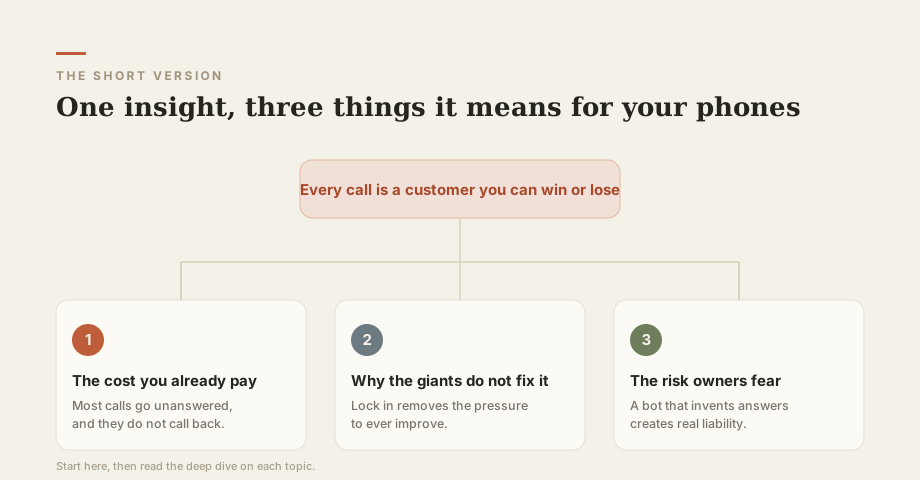
The businesses most able to fix their customer service often have the least reason to. The ones with every reason to fix it are frequently the most afraid. This is the short version of why, with links to dig into each part.
Quick answer: Big companies keep frustrating phone systems because their customers are locked in, so bad service costs them almost nothing. Small businesses face the opposite: a single missed or mishandled call can lose a customer who leaves instantly. That is why owners are cautious about AI, even though the larger and more certain loss is the calls already going to voicemail. The fix is an AI assistant with a narrow job that answers only from your own information and hands sensitive calls to a human.
This week I had to call my insurance company about a claim.
You know how this goes. Press 1 for English, 2 for French. Press 1 if you are a member, 2 if you are a provider. Press for the type of benefit. Press if it is dental, health, vision. Four or five layers of this before a human, or more often the promise of a human, was anywhere in sight.
It struck me how strange this is. This is a large, sophisticated, well funded company. It could obviously afford a modern system that simply understands what I am calling about and routes me in one step. The technology exists, it is affordable, and it has been for a while. So why am I still pressing buttons like it is 2009?
And here is the part that kept me thinking. At the very same time, I keep meeting small business owners, the dentist, the law office, the HVAC company, who are nervous about adopting exactly the kind of smart assistant the giant insurer cannot be bothered to install. The people who could most easily upgrade will not. The people who would benefit most are scared to.
The short version
Here is the pattern in one breath. Big companies keep bad phone systems because their customers are locked in, so poor service costs them almost nothing. Small businesses are the opposite: a customer can leave after a single bad call, which makes owners cautious about new tools, even though the larger and more certain loss is the calls already slipping to voicemail. Read that tension correctly and it turns into an advantage, because the giant has no reason to be great, and you do.
The same idea touches three concrete things for any small business.
Where this goes, in three parts
This idea is simple, but each part deserves a proper look. Here is where to go deeper:
- The cost you are already paying. Most small business calls never reach a person, and most of those callers do not come back. See the numbers in The Real Cost of Missed Calls for Small Businesses.
- Why the giants do not fix it. The economist Albert Hirschman explained the lock in dynamic back in 1970: when customers cannot easily leave, a company feels little pressure to improve. See Why Big Companies Keep Terrible Phone Systems.
- The risk owners fear. A chatbot that invents answers can create real liability, as Air Canada learned in 2024 when a tribunal held it responsible for a promise its bot made up. The fix is an assistant that answers only from verified information. See Can a Chatbot Legally Commit Your Business? The Air Canada Case Explained.
- Voicemail, answering service, or AI? Each handles calls differently, and the pricing models are not comparable. See AI Receptionist vs Answering Service vs Voicemail: An Honest Comparison.
- A trade example: dental. New patient calls are high value and easy to miss, and most callers who hit voicemail just book elsewhere. See Why Dental Practices Lose New Patients to Voicemail.
How Zalena fits
We built Zalena around one principle: give the AI a narrow, well defined job and a human safety net. It answers calls and messages across phone, chat, SMS, WhatsApp, and Instagram around the clock, responds only from your own information, will not promise anything it cannot verify, and hands off to a person the moment a call needs judgment. It comes preconfigured for trades like dental, legal, home services, and restaurants, at one flat monthly price. The goal is not to replace the relationship you have with your customers. It is to stop you losing customers before that relationship ever begins.
The big companies will keep their phone trees, because nothing forces them to change. You do not have that luxury, and that is not a weakness. It is the reason a small business that gets this right can deliver service that feels better than the giant's. You just have to point the technology at the right risk.
FAQ
Why do big companies keep such frustrating phone systems? Because their customers are locked in. When people cannot easily leave, bad service costs the company very little, so there is little pressure to improve. The economist Albert Hirschman described this as "exit versus voice."
Are small businesses right to be cautious about AI on their phones? The caution is rational, because a single bad interaction can lose a customer who can switch instantly. The mistake is concluding the answer is to avoid AI, rather than to use one that is scoped and grounded.
What is the biggest hidden cost of poor phone handling? The calls that never get answered. Studies of small business phones find only about 38% of calls are answered live, and most callers who reach voicemail do not call back.
How can a small business use AI for calls safely? Use an assistant that answers only from your own information, will not quote or promise anything it cannot verify, and escalates sensitive or unusual calls to a human.
Sources
- Albert O. Hirschman, Exit, Voice, and Loyalty (Harvard University Press, 1970).
- The data and case behind each section are cited in the linked guides above.
Get new posts in your inbox
Notes on AI assistants, customer experience, and what's working for the small businesses building on Zalena. No spam.