Why Big Companies Keep Terrible Phone Systems, and Small Businesses Fear Better Ones
Big companies keep frustrating phone trees because customers cannot leave. Small businesses face the opposite risk, and it is their biggest advantage.
A note on optionality, risk, and why the company most able to fix its customer service has the least reason to.
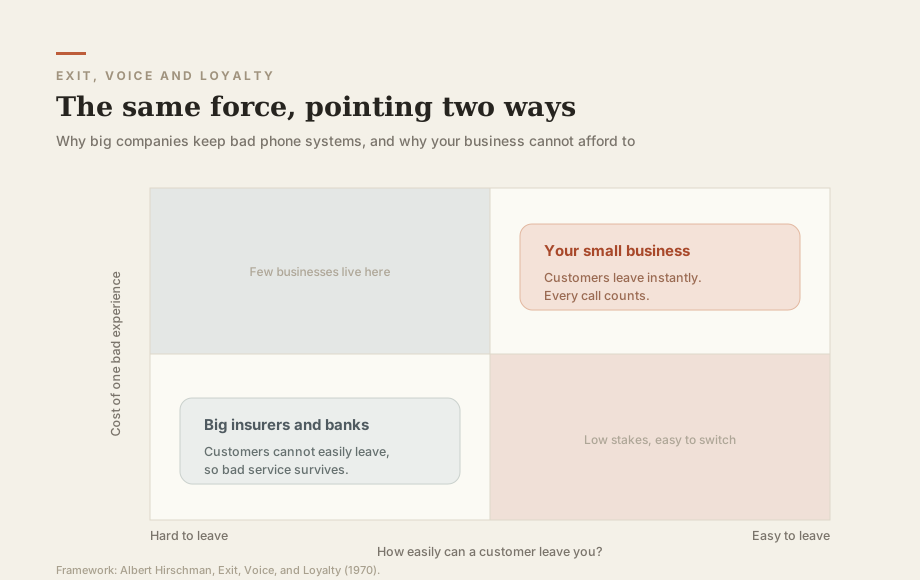
Quick answer: Big companies keep frustrating phone trees because their customers are locked in. When people cannot leave, bad service costs almost nothing, so it never gets fixed (the economist Albert Hirschman called this "exit versus voice"). Small businesses face the opposite. Customers can leave instantly and one bad experience is costly, which is why owners are cautious about new tools. But that same exposure is a small business's biggest advantage, and the reason it can deliver service that beats the giants.
Why do big companies get away with bad phone systems?
Picture being stuck in an insurance phone tree. Press 1, press 2, press for the benefit type, with a human nowhere in sight. If your insurance comes through your employer, you cannot switch, because HR chose for you. When customers cannot leave, complaints are easy to ignore and the pressure to improve disappears.
As Hirschman described in Exit, Voice, and Loyalty (1970), unhappy customers push back two ways: they leave ("exit") or they complain ("voice"). Exit is the signal companies actually feel, because it costs money. Lock in removes that signal. So the giant's terrible phone tree is not a mistake. From inside that company, keeping it is perfectly rational. Lock in is an anesthetic.
Why do small businesses feel the opposite?
Flip it. When someone calls your shop and does not get through, they do not complain. They call the next business on Google, and you feel it the same day. A big company can survive a clumsy interaction because the customer is trapped anyway. A small business can lose a customer over a single one. So when an owner hesitates over a new tool, that caution is not technophobia. It is a rational read of real exposure.
So is that exposure a weakness?
No. It is the advantage. Because you have to care about every call, you can build an experience that feels warmer, faster, and more personal than any giant's, precisely because the giant has no reason to bother. The frontier of great service is wide open, and it is the small, exposed players positioned to take it. The tools to answer every call instantly now cost less than the customers you lose to voicemail. They set up in minutes at a flat monthly price, not a six figure project.
What this means if you run a small business
The practical takeaway is liberating once it clicks. You will never win by waiting the way a big company waits, because nothing protects you the way lock in protects them. But you do not need to. Your exposure is your edge. It pushes you toward service so good that leaving never crosses a customer's mind. That no longer requires an enterprise budget. The owners who understand this early get to deliver, on a small business budget, the always available experience their largest competitors cannot be bothered to build.
Which industries live on the exposed side of this line?
Businesses whose customers can switch in one click or one call, where service quality is survival:
- Salons, spas, barbershops, and gyms.
- Home services (pest control, HVAC, plumbing, electrical, cleaning).
- Restaurants, cafes, and local food businesses.
- Computer and IT repair, auto repair, and other local trades.
- Independent ecommerce and local retail.
Contrast them with the locked in sectors (insurance, banking, utilities, telecom) that can afford to make you press five buttons.
FAQ
Why do large companies have such frustrating customer service? Often because customers cannot easily leave. When exit is not an option, poor service carries little cost, so there is little pressure to fix it. The economist Albert Hirschman described this as "exit versus voice."
Why are small businesses cautious about new customer service tools? Because their exposure is real. A single bad interaction can lose a customer who can switch instantly. The caution is rational risk management, not fear of technology.
How can a small business beat a big company on service? By using its exposure as motivation: answering every call, responding instantly, and staying personal, with tools now affordable enough to make always on service realistic.
What is exit, voice, and loyalty? A 1970 framework by Albert Hirschman. Unhappy customers either leave (exit) or complain (voice). Exit is the stronger signal, and lock in removes it.
Part of our series on small business phone strategy. Start with the overview, Press 1 for English: What My Insurance Company Taught Me About AI.
Sources
- Albert O. Hirschman, Exit, Voice, and Loyalty (Harvard University Press, 1970).
- 411 Locals, small business call answer study (context for the cost of missed calls).
Get new posts in your inbox
Notes on AI assistants, customer experience, and what's working for the small businesses building on Zalena. No spam.