Do I Have to Tell Customers They're Talking to an AI? Legally, Probably Not. Practically, Yes.
California's new chatbot law skips small businesses, but its three rules are what stop callers hanging up. What to copy, with a worked example.
This article is general information, not legal advice. For your situation, consult a qualified lawyer.
On 28 September 2026, California's governor signed a bill that tells the largest companies in the state how their chatbots and phone bots must behave from 1 January 2027: say it's a bot, offer a human, keep the promise (Kelley Drye). Since then, the question we keep hearing from owners is "do I have to tell customers they're talking to an AI?" Picture who asks: a physio clinic, a two-truck electrical outfit, a small real estate office. None is anywhere near California or the revenue threshold, and the answer for all of them is the same. The law does not bind you. Follow it anyway, because the rules it sets are the ones that stop callers hanging up.
Does this California law even apply to me?
No. AB 1609 covers "large private businesses" with more than $500 million in gross annual revenue nationally, and it takes effect on 1 January 2027 (Holland & Knight). Civil fines run up to $5,000 for a first violation and $10,000 for each one after, with no private right of action (Holland & Knight). It also exempts hospitals, consumer reporting agencies, regulated utilities and certain business-to-business dealings (Kelley Drye). A six-person clinic in Calgary, a plumber in Leeds, a café in Utrecht: none of you is covered.
It still matters, because laws like this set the public's definition of acceptable. Once the bank and the airline have to say "this is an automated assistant" and offer a person within fifteen minutes, your customers will expect the same from the dentist and the roofer.
What does it make big companies do?
Three things.
- Never pass a bot off as a person. A covered business may not represent a chatbot as human, and must disclose when the customer is dealing with one (Holland & Knight; CommLaw Group).
- Give people a simple way to ask for a human. During regular business hours, the business must make a good-faith effort to connect the customer to a person within 15 minutes of the request, or schedule an appointment within one business day (Kelley Drye; CommLaw Group).
- Post customer-service contact details on the website (Holland & Knight).
The bill does not name channels (Kelley Drye). Treat it as covering voice, SMS and web chat anyway; that is how the public will read it.
Is this just California, or is it coming everywhere?
Netherlands and the rest of the EU. Article 50 of the EU AI Act has applied since 2 August 2026 (EU AI Act, Article 50). Providers must design systems that interact with people so that those people are "informed that they are interacting with an AI system", unless that is already obvious in context, and the information must arrive "at the latest at the time of the first interaction or exposure" (EU AI Act, Article 50). Note who carries the duty: the provider of the AI system, not the café or clinic that switches it on. In the Netherlands, ask your vendor, in writing, how their tool meets Article 50.
UK. Outside the EU AI Act, but the same worry shows up. Ofcom reported on 25 September 2026 that 53% of UK adult internet users had interacted with a generative AI tool or an AI customer-service chatbot in the past 12 months, with views mixed: some prefer AI, others worry about not being able to reach a person and cite a lack of empathy (Ofcom).
Canada. We could not confirm a federal AI-disclosure statute in force at the time of writing; ask a lawyer before relying on that.
US outside California. We have not verified other states' rules for this post; check yours.
Will people really hang up on an AI?
A survey of 6,000 people across the US, UK and Canada, run in October 2025 and again in April 2026, found that 31% say they would hang up if connected to AI (Business Journal Daily). Preference for a real person rose from 83% to 85%, those preferring AI fell from 7% to 5%, frustration with AI agents climbed from 54% to 59%, and 57% said their trust in a business would drop if it predominantly used AI, up from 53% (Business Journal Daily).
Two honesty notes: AnswerConnect, which sells human answering services, released the survey, and it does not separate phone from chat.
Our view, after setting up a lot of these systems: those numbers measure resentment at being fooled and trapped, not hatred of software. People hang up on "Sandra" when they realise Sandra isn't real and there is no way past her. They rarely hang up on a clearly labelled assistant that offers a person and books a call-back.
And the honest comparison for a small business is not AI versus human, because the human is on a ladder or in a treatment room. The real alternative is voicemail. This blog has already run those numbers in The Real Cost of Missed Calls for Small Businesses (2026 Data): small businesses answer only about 38% of inbound calls, and in our experience an after-hours caller who hits voicemail leaves a message far less often than one who reaches a labelled assistant offering a call-back.
So do I have to tell customers they're talking to an AI? Say it in the first five seconds
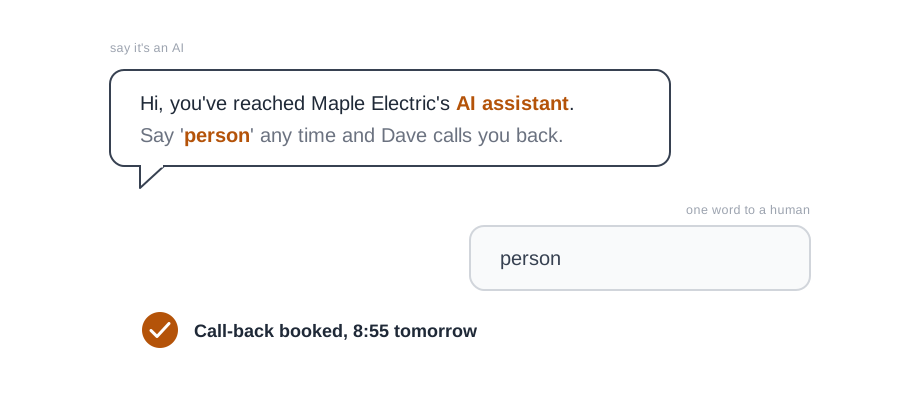
Legally, for most readers, no. Practically, yes, right away. Article 50 sets the timing standard worth copying: at the first interaction, clear and distinguishable (EU AI Act, Article 50). The greeting should carry the business name, the word "assistant" or "AI", and the escape route, before anything else:
"Hi, you've reached Maple Electric's AI assistant. I can book you in or take a message. Say 'person' any time and I'll get Dave to call you back."
Pretending to be Sandra is a trap. It is what California now bans for large companies (Holland & Knight). It is what the 31% are reacting to. And it collapses the moment someone asks "wait, is this a real person?" Set one hard rule in the configuration: the assistant answers that question with a plain "I'm an AI" and nothing else.
Fifteen minutes to a human, when the human is me, on a ladder?
The rule contains its own answer: connect within 15 minutes, or schedule an appointment within one business day (Kelley Drye; Holland & Knight). The law for companies with over $500 million in revenue allows a scheduled call-back. So can you.
During business hours: transfer if someone is free; otherwise promise a call-back with a stated time and have the system hold you to it. After hours: book the first slot tomorrow and send a text confirmation. What keeps the caller is the promise with a time on it, not the speed.
Worked example (illustrative, made-up numbers)
Picture a two-electrician shop in Mississauga, week of 19 to 25 October. 60 inbound calls, 22 of them after 5 pm or on the weekend. Both electricians are on jobs; the AI answers all 22.
Version A. The assistant is set up to sound like a human receptionist named Sandra, with no way to ask for a person. Assume the survey's 31% plays out: roughly 7 of 22 catch on and hang up; 15 leave details.
Version B. The assistant opens with "Hi, you've reached Maple Electric's AI assistant; say 'person' any time and I'll get Dave to call you back by 9 tomorrow," and books every caller a call-back slot. Assume 2 of 22 still hang up; 20 leave details.
The arithmetic:
- Extra callers captured: 20 minus 15 = 5 per week
- Assume 2 in 5 become jobs (our assumption, not a sourced figure): 5 x 0.4 = 2 jobs
- Assume an average job of $450 CAD: 2 x $450 = $900 a week
- Over a 50-week year: $900 x 50 = $45,000
A script change that cost nothing. Dave calls at 8:55 the next morning, clearing California's standard on a call the law doesn't even cover.
The six rules to borrow from the big-company rulebook
- Say it's an AI in the greeting. Business name plus "assistant" or "AI", first sentence.
- One-word escape to a human that works on every channel. "Person" on the phone, "human" in web chat, the same result on WhatsApp.
- A call-back promise with a time, and a system that keeps it. "By 9 tomorrow" beats "someone will be in touch."
- After hours means booked within one business day, confirmed by text or email. The confirmation is proof the promise is real.
- Phone number and email visible on the website and your Google listing. The one rule from AB 1609 you can satisfy in ten minutes (Holland & Knight).
- A monthly listen-back. Pull transcripts where a caller asked for a human and check one followed.
Sector notes. Clinics: California's companion bill AB 1979 exempts tools used for administrative functions "such as scheduling and appointment reminders" (Holland & Knight). Stay on that side of the line, booking and intake only; never triage symptoms or give clinical advice. Law and real estate offices: check your professional-conduct rules on client communication; we won't guess at them. Restaurants and salons: reaching a human in 15 minutes is easy when the phone rings beside the till; your exposure is web chat and WhatsApp at 11 pm with nobody watching, where rule 4 earns its keep.
None of this needs a lawyer or a compliance budget. It needs a greeting that tells the truth, one word that reaches a person, and a call-back time you keep. If you want to hear what that sounds like in practice, Zalena runs a live demo that answers exactly that way.
Sources
- Holland & Knight, client alert on AB 1609 and AB 1979 ("Keeping Humans in the Loop"), 15 Oct 2026. https://www.hklaw.com/en/insights/publications/2026/10/keeping-humans-in-the-loop-california-sets-new-ground-rules
- Kelley Drye, Ad Law Access blog, California 2026 legislative session wrap-up, 14 Sept 2026 (updated 5 Oct 2026). https://www.kelleydrye.com/viewpoints/blogs/ad-law-access/californias-2026-legislative-session-wraps-a-wave-of-privacy-and-ai-bills-reaches-the-governor-with-key-child-safety-and-ai-measures-signed-into-law
- The CommLaw Group, California consumer-protection and customer-service requirements note, 9 Oct 2026. https://commlawgroup.com/2026/california-enacts-new-consumer-protection-and-customer-service-requirements/
- EU Artificial Intelligence Act, Article 50 (artificialintelligenceact.eu), in force 2 Aug 2026. https://artificialintelligenceact.eu/article/50/
- Business Journal Daily, report on backlash against AI in customer service (AnswerConnect survey), 15 May 2026. https://businessjournaldaily.com/report-backlash-grows-against-ai-in-customer-service/
- Ofcom, consumers using AI to manage telecoms services but human contact still valued, 25 Sept 2026. https://www.ofcom.org.uk/phones-and-broadband/telecoms-infrastructure/consumers-using-ai-to-help-manage-their-telecoms-services-but-human-contact-still-valued
Get new posts in your inbox
Notes on AI assistants, customer experience, and what's working for the small businesses building on Zalena. No spam.