What Does an AI Receptionist Cost Per Call? How to Compare Any Quote
Turn any AI receptionist quote into one number: what you pay each time the phone rings. Real price lists, a worked method and a 200-call comparison.
How to turn any quote into one number, and how to tell whether that number is fair.
Quick answer: An AI receptionist's cost per call is your full monthly bill divided by the calls you actually get. On public price lists read on November 2, 2026, a business taking 200 calls a month pays roughly US$0.65 to US$2.10 a call, depending on the pricing model and how long calls run. Under US$1 is normal for self-serve products, and a human receptionist runs about US$7 to US$10. Call length decides more than the plan price does, so use your real call log, then rerun the sum for your busiest month.
AI receptionist prices do not line up. One vendor sells minutes, one sells calls, one sells customers, and one adds the receptionist to your scheduling software. Each price looks reasonable on its own page, and none can be held up against the others.
So convert them. Every quote can be turned into a single number: what you pay each time the phone rings.
A disclosure before the math. We build Zalena, which sells one of these and charges by the minute. We have kept it out of the comparison below, used only prices anyone can look up, and shown the working so you can check it. Zalena gets its own section further down, with the same 200-call examples and the same arithmetic, in Canadian dollars because that is how we bill. All other prices are in US dollars, as listed on vendors' sites on November 2, 2026.
What are the four ways AI receptionists are priced?
1. By the minute. You buy a bundle of minutes. Rosie sells 250 minutes for $49, 1,000 for $149 and 2,000 for $299. It has no per-minute overage: go past your plan and it moves you up a plan. Dialzara sells 220 minutes for $99, 500 for $199 and 1,000 for $349, and bills extra minutes at $0.45, $0.40 and $0.35. Call length is your problem: if your callers like to talk, you pay for it.
2. By the call. Upfirst sells 300 calls for $159.95, with extra calls at $0.75. Smith.ai's AI receptionist has a free tier of 25 calls, and paid plans start at 75 calls for $150. The vendor carries the long calls. You carry the definition of a call, so read it.
3. By the customer. Goodcall charges $129 for 500 unique callers a month and says it never meters minutes. Someone who phones three times counts once. Good for repeat callers, less so if every call is a stranger.
4. Inside something else. Jobber's receptionist is a $29 add-on that covers 30 conversations, then costs $0.79 each, or you can pause at the limit. Its Plus plan includes it unlimited. Cheap at low volume if you already live in that software, but the real price is the platform.
There is a fifth kind, the one with no price at all: "talk to sales". Nothing is wrong with that for a large business. For a small one, it means you can't compare before the call.
How do you work out cost per call?
You need two numbers: your calls per month and your average call length. Your phone provider's call log has both. Do not guess the second one, because it decides the outcome.
Then the sum is short:
Cost per call = your full monthly bill ÷ the calls you actually get.
The full bill means the plan you would really need plus any overage, not the headline price of the cheapest plan. Here is the whole method, using a business with 200 calls a month averaging 3 minutes.
- Get your minutes. 200 calls × 3 minutes = 600 minutes a month.
- Price every plan that could work, not just the closest one. On Dialzara, the $99 plan costs $99 + (380 extra minutes × $0.45) = $270. The $199 plan costs $199 + (100 × $0.40) = $239. The $349 plan covers everything for $349.
- Keep the cheapest. That is $239, and neither the lowest headline price nor the plan that fits on paper would have told you so.
- Divide. $239 ÷ 200 calls = $1.20 a call.
- Add what the quote left out. Extra agents, chat sessions, the platform underneath, all before you divide.
- Rerun it for your busiest month. More on that below.
If your vendor sells calls or customers, count those in step 1 instead of minutes.
What does 200 calls a month really cost?
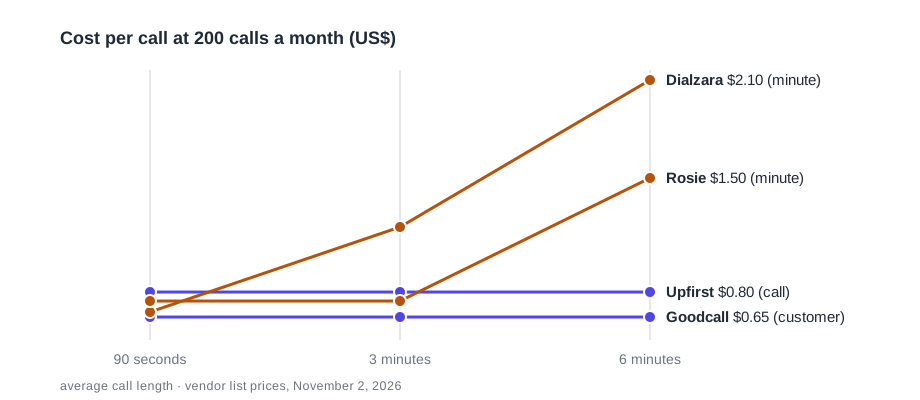
Here is that business on the six public price lists where the sum can be done. The only thing that changes across the columns is how long the calls run.
| Vendor (how it bills) | 90 seconds (300 minutes) | 3 minutes (600 minutes) | 6 minutes (1,200 minutes) |
|---|---|---|---|
| Goodcall (customer) | $129, or $0.65 a call | $129, or $0.65 | $129, or $0.65 |
| Dialzara (minute) | $135, or $0.68 | $239, or $1.20 | $419, or $2.10 |
| Rosie (minute) | $149, or $0.75 | $149, or $0.75 | $299, or $1.50 |
| Upfirst (call) | $159.95, or $0.80 | $159.95, or $0.80 | $159.95, or $0.80 |
| Jobber add-on (conversation) | $163.30, or $0.82 | $163.30, or $0.82 | $163.30, or $0.82 |
| Smith.ai AI (call) | about $385, or $1.93 | about $385, or $1.93 | about $385, or $1.93 |
US dollars, read November 2, 2026. Monthly billing, before tax. The rows are in the order of the first column, and the order is not a ranking.
Same phone, same business, and the second-cheapest option at 90 seconds is the most expensive at 6 minutes. That is why comparing plan prices tells you very little.
Check our working, because each figure rests on an assumption:
- Goodcall assumes all 200 calls come from different people, which is the worst case for it. Repeat callers bring the number down.
- Dialzara at 90 seconds is $99 + (80 × $0.45). At 6 minutes it is $349 + (200 × $0.35).
- Jobber is $29 + (170 × $0.79), assumes one conversation per call, and sits on top of the platform you pay for separately.
- Smith.ai is the 150-call tier, which we work out as $270 from its listed $1.80 a call, plus 50 extra calls at $2.30. We use "about" because that tier price is derived, not quoted.
This is not a ranking. These products do different things, and this table compares cost, not quality.
How long is a real call?
Ruby, a human answering service, says a typical inbound call takes around 2 receptionist minutes. NextPhone, an AI vendor, reports a median of 77 seconds on business lines, with 90% of conversations under 3.5 minutes. Both are vendors describing their own traffic, so treat them as a sanity check on your call log, not a replacement for it.
A median is not an average, either. A few long calls pull your bill above what the typical call suggests.
Why should you model the bad month?
Now double the calls. Take the same business at 400 calls, 3 minutes each, which is 1,200 minutes.
| Vendor | 200 calls | 400 calls | Per call at 400 |
|---|---|---|---|
| Goodcall | $129 | $129 | $0.32 |
| Upfirst | $159.95 | $234.95 | $0.59 |
| Rosie | $149 | $299 | $0.75 |
| Jobber add-on | $163.30 | $321.30 | $0.80 |
| Dialzara | $239 | $419 | $1.05 |
| Smith.ai AI | about $385 | about $718 | $1.80 |
Goodcall stays at $129 as long as you stay under 500 unique callers. The others rise. Your busiest month is when you most need this working, and it is also when the bill jumps, so price the quote at your worst month. Our comparison of AI receptionists, answering services and voicemail covers the human options, and a missed call has a cost of its own to weigh all of this against.
What does Zalena cost per call?
Here are our own prices through the same method. Zalena meters minutes and has overage. Plans are in Canadian dollars, plus tax, as listed on our pricing page:
| Plan | Monthly price | Minutes included | Extra minute | Cap on extras | Total minutes at the cap |
|---|---|---|---|---|---|
| Answer | CA$49 | 150 | CA$0.30 | CA$100 (333 minutes) | 483 |
| Book | CA$149 | 500 | CA$0.25 | CA$150 (600 minutes) | 1,100 |
| Team | CA$299 | 1,200 | CA$0.22 | CA$299 (1,359 minutes) | 2,559 |
The cap works like this. Extra minutes are billed at the end of the month, up to the price difference to the next plan (on Team, its own price again). Past the cap, the assistant stops taking new calls and they ring your own phone until your minutes start again, or until you move up a plan. A call in progress is never cut off. So the cap limits your bill by sending calls back to you. Calls under 15 seconds are not counted.
One difference affects the comparison: Answer takes booking requests for you to confirm, while Book puts appointments straight into the calendar. If you need live booking, ignore the Answer column.
Here is the same business at 200 calls.
| Average call | Answer | Book | Team |
|---|---|---|---|
| 90 seconds (300 minutes) | CA$49 + (150 × CA$0.30) = CA$94, or CA$0.47 a call | CA$149, or CA$0.75 | CA$299, or CA$1.50 |
| 3 minutes (600 minutes) | Hits the cap: about CA$149, and 39 calls ring your phone | CA$149 + (100 × CA$0.25) = CA$174, or CA$0.87 | CA$299, or CA$1.50 |
| 6 minutes (1,200 minutes) | Hits the cap: about CA$149, and 120 calls ring your phone | Hits the cap: CA$299, and 17 calls ring your phone | CA$299, or CA$1.50 |
Canadian dollars, before tax, monthly billing. A cell that hits the cap has no cost per call worth quoting, because not every call was answered.
Where a plan hits the cap, it is a false economy. At 3 minutes, Answer stops at 161 calls for about Book's base price, so Book at CA$174 is the real figure. At 6 minutes, Book stops at 183 calls and costs the same as Team, so Team is.
The bad month works the same way. At 400 calls of 3 minutes, Book hits its cap with 34 calls ringing your phone, for CA$299. Team covers all 1,200 minutes for the same CA$299, or CA$0.75 a call. So CA$174 becomes CA$299, and it pays to move up before that month, not during it.
So the cost per call is CA$0.47 at 90 seconds (Answer), CA$0.87 at 3 minutes (Book) and CA$1.50 at 6 minutes (Team). At about 0.71 US dollars to the Canadian dollar, a rough rate that moves, that is about US$0.33, US$0.62 and US$1.06. We bill every customer in Canadian dollars, including in the US.
We wrote this section about ourselves, so read it as you would any vendor's page: rerun it with your own call log and put the questions below to us too. It is not a ranking either. Our cost per call says nothing about whether our assistant handles your calls better or worse than anyone else's, and at long call lengths we are not the cheapest on this page.
Is the quote fair?
Two reference points tell you most of what you need.
The ceiling is a person. Smith.ai's human receptionists run $7 to $10 a call within plan. Ruby plans work out to $3.45 to $5 a minute, which at its own 2-minute typical call comes to about $7 to $10 as well. If an AI quote gets anywhere near that, you are paying people prices for software.
The floor is the parts. Retell, which sells voice AI to developers, shows about $0.11 a minute in its default estimate, or roughly $0.125 with US phone charges. That is around $0.19 for a 90-second call and $0.38 for a 3-minute one. No small business pays that, because it buys parts, not a working receptionist: someone still has to build it, test it and fix it when it breaks. But it shows how much of a quote is service rather than technology.
Between those, here is our rule of thumb for a small business that needs calls answered and appointments booked, at normal call lengths. It is a judgment from the price lists above, not an industry standard.
- Under $1 a call: normal for self-serve today.
- $1 to $2: fair if you can name what the extra buys. Done-for-you setup, a person you can call, or an integration you need.
- $2 to $5: needs a specific reason, such as regulated work or a deep integration into your industry's software.
- Over $5: you are close to the price of a human. Ask why you are not hiring one.
Six questions that find the rest of the bill
The per-call number only works if the bill is what the quote says. These find the gaps.
- What counts? Upfirst does not bill spam, calls under 15 seconds or calls where nobody speaks. Smith.ai filters known spam before answering. Ask for the definition in writing.
- What happens past the limit? Listed overage runs from $0.35 to $0.48 a minute at Dialzara and $0.70 to $1.50 a call at Upfirst. At Dialzara, callers can go to voicemail at zero balance unless auto-recharge is on. Ask whether there is a cap, and whether it keeps answering when you hit it.
- Does the meter run during a transfer? If the AI passes a caller to you and you talk for ten minutes, ask whose minutes those are.
- What is extra? Phone number, text messages, website chat, a second agent. Upfirst charges $9.95 a month for each additional agent. At Dialzara, website chat is free for the first 100 sessions with a voice plan, then $0.15 each.
- What does it cost to start and to stop? Dialzara, Ruby and Smith.ai's human service all advertise no setup fee, and most of the plans above run month to month. So a large setup fee or an annual lock-in on a small account needs an explanation.
- Will the price follow the cost? These systems keep getting cheaper to run. Ask what happened to your price the last time theirs dropped.
Which number matters more than cost per call?
Cost per call is a way to compare quotes. It is not the decision. A $1.20 call that books the job beats a $0.65 call that does not, and the only way to know which you are buying is to test it on your own calls before you commit. Upfirst offers 14 days without a card. Rosie and Dialzara offer 7. Ours is 14 days of the Book plan with 50 minutes and a local number, and it needs a card to start. Forward real calls and listen to the recordings.
FAQ
How much does an AI receptionist cost per call? On public price lists read on November 2, 2026, a business taking 200 calls a month pays roughly US$0.65 to US$2.10 a call, depending on the vendor's pricing model and how long the calls run. Under US$1 a call is normal for self-serve products.
Is per-minute or per-call pricing better? It depends on how long your calls run. Per-minute plans are often cheaper for short calls, and per-call plans protect you when calls run long. Run both at your own average call length and at your busiest month.
Does Zalena charge by the minute? Yes. Zalena plans include minutes, CA$49 for 150, CA$149 for 500 and CA$299 for 1,200, and extra minutes cost CA$0.30, CA$0.25 or CA$0.22 up to a monthly cap. Past the cap, calls ring your own phone until your minutes start again or you move up a plan.
When is an AI receptionist quote too high? As a rule of thumb, over US$2 a call needs a specific reason, such as regulated work or a deep integration, and over US$5 you are close to the price of a human receptionist, who runs about US$7 to US$10 a call.
Part of our series on small business phone strategy. If your calls come from ads, see how Google Local Services Ads now charge for missed calls. Browse all posts.
Sources
All vendor pages read November 2, 2026.
- Rosie, pricing. https://heyrosie.com/pricing
- Dialzara, pricing. https://www.dialzara.com/pricing
- Upfirst, pricing. https://upfirst.ai/pricing
- Smith.ai, AI receptionist pricing. https://smith.ai/pricing/ai-receptionist
- Smith.ai, virtual receptionist pricing. https://smith.ai/pricing
- Goodcall, pricing. https://www.goodcall.com/pricing
- Jobber, Receptionist powered by Jobber AI, Help Center. https://help.getjobber.com/en/articles/receptionistpowered-by-jobber-ai/
- Ruby, pricing. https://www.ruby.com/pricing/
- Ruby, "How long is an average call?", Help Center. https://rubyhelpcenter.helpjuice.com/billing-plans/how-long-is-an-average-call
- NextPhone, AI receptionist call report 2026. https://www.getnextphone.com/reports/ai-receptionist-call-report-2026
- Retell AI, pricing. https://www.retellai.com/pricing
- Zalena, pricing. https://zalena.ai/pricing
Get new posts in your inbox
Notes on AI assistants, customer experience, and what's working for the small businesses building on Zalena. No spam.