In early October, a startup called Voygr had its AI agent place 848 phone calls to local businesses over a few hours. The calls asked simple questions, such as a salon’s cheapest haircut or whether a dentist was taking new patients. About 1 in 3 respondents stayed on the line after hearing they were talking to an AI, according to the SF Standard. If you’ve had an AI calling your business to book a table, a cleaning or a grooming slot, you’ve probably made the same snap decision: stay or hang up.
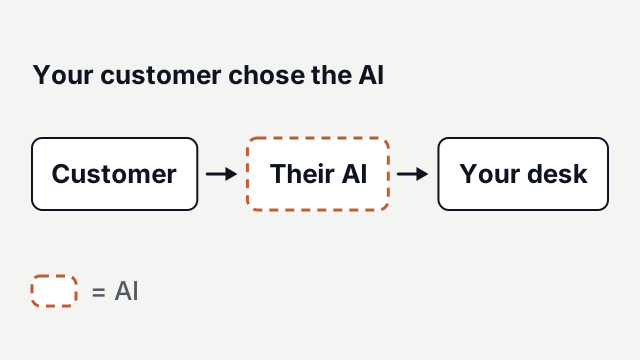
An AI agent calling to book is usually a real customer who handed the phone to software. Hanging up means hanging up on that customer. You do need a few rules, though, and they fit on a sticky note.
Why are AI assistants suddenly calling businesses to book?
Because AI assistant apps can now make phone calls for their users. In September, Meta’s Muse started calling U.S. businesses, and a rival app called Instinct launched the same feature, TechCrunch reported. People use them to book a table at a restaurant with no online booking, or to get on a dentist’s cancellation list. OpenAI’s dots makes these calls too, says the SF Standard.
What about Canada? For now, Muse calls U.S. businesses, and neither report mentions Canada. We expect these calls to show up first at Canadian businesses near the border, in tourist areas, or with many American customers.
Is AI booking call a scam, spam or a real customer?
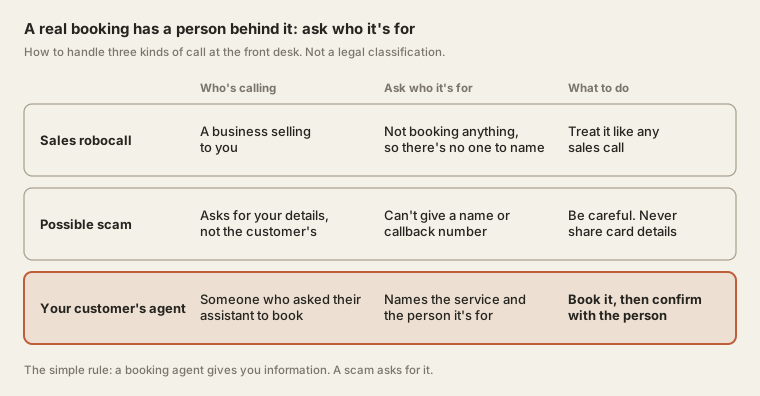
Usually a real customer. A robocall is someone trying to sell to you. An AI booking agent is someone trying to buy from you. A person asked their assistant to book a table or a spot on your cancellation list, and the assistant made the call.
The catch is that these agents don’t always say who they are. An e-bike shop employee told the SF Standard the calls he gets never name the company behind them. So ask the caller two questions: “Which app or service are you calling from?” and “Who are you booking for?” A real booking agent should be able to answer both.
Be careful if the caller:
- asks for your information (account numbers, staff names, payment details) instead of giving you the customer’s
- pushes you to read out or confirm card details
- can’t give the customer’s name or a callback number
The simple rule: a booking agent gives you information. A scam asks for it.
What happens when businesses hang up versus keep talking?
In Voygr’s test, staff at vet and dental offices were the most willing to keep talking, while dry cleaners and bars were most likely to hang up. Remember these were question calls, not bookings, so they measure patience rather than revenue. Still, the split tracks how each business earns money: at a vet or a dentist, the appointment is the business. A dry cleaner doesn’t need you to call ahead.
Customers share the urge to hang up on bots. AnswerConnect, which sells human answering services, released a OnePoll survey of 6,000 consumers in the US, UK and Canada. In it, 85% said they prefer dealing with a person and 31% said they would hang up if connected to AI (PR Newswire via Yahoo Finance, May 13, 2026). Owners feel it too. Kash, who owns Warm Planet Bikes, told the SF Standard: “It smacks of trying to get between business and the customer.”
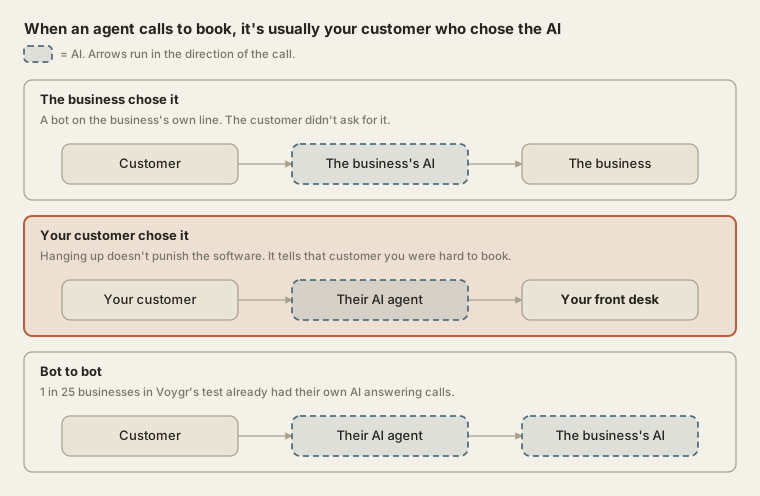
What changes the math is who chose the AI. When a business puts a bot on its own line, the customer didn’t ask for it. When an agent calls you, your customer picked it. Hanging up doesn’t punish the software. It tells that customer you were hard to book.
Where do AI booking calls break down?
At the money. Colleen Booth, COO of Lazy Bear Restaurant Group, told the SF Standard that as far as she knows, no AI agent has successfully made a reservation at Lazy Bear, True Laurel or Jou Jou. Booth said agents “often get stuck at the payment phase of the reservation.”
That’s the predictable failure point for any business that takes deposits or card holds, and it’s the right place for the call to stop. Never read card numbers to software or take them from it.
Move payment off the call instead:
- Take the booking details from the agent.
- Text or email a deposit or card-hold link to the customer’s own number or email.
- Hold the slot for whatever window you already give phone bookings.
- Confirm directly with the person, not the agent.
What should my front desk say when AI is calling my business to book?
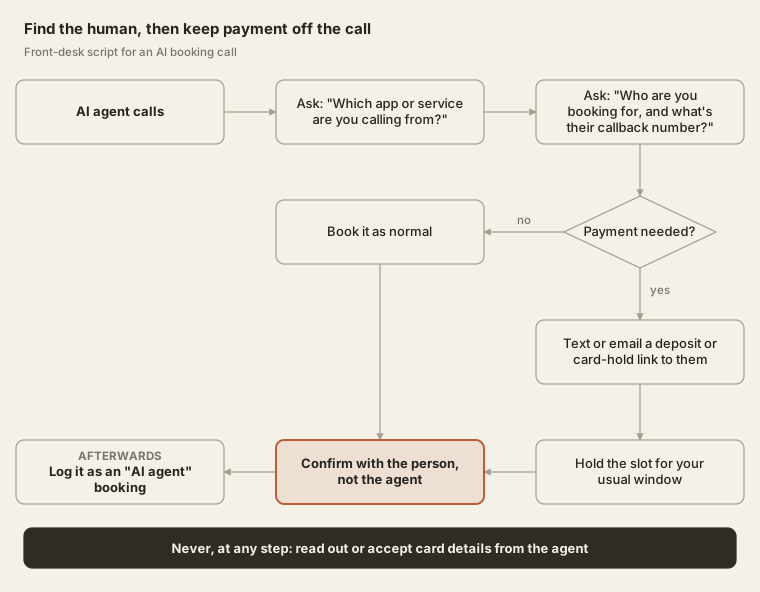
Treat it like any third-party booker. Here’s a script you can tape next to the phone.
| Step | What to say or do |
|---|---|
| Identify | “Which app or service are you calling from?” |
| Find the human | “Who are you booking for, and what’s their callback number?” |
| No payment needed | Book it as normal and send your usual confirmation to the customer’s number. |
| Deposit or card hold needed | “I’ll text a deposit link to that number. We’ll hold the slot for our usual window.” |
| Never | Read out or accept card details from the agent. |
| Afterwards | Log it as an “AI agent” booking. |
That last row matters more than it looks. Tag agent calls as their own source in your booking system or a notebook by the phone, and after a month you’ll know whether this is a curiosity or a channel worth training for.
What could this be worth? A worked example
Illustrative example: a two-chair dental office. Every number here is made up except one, and that one comes from a different kind of business: an employee at The New Wheel, an e-bike shop, told the SF Standard he answers one or two agent calls a week. We use it only as a placeholder, so swap in your own figures.
- Say the office gets 2 agent calls a week.
- Over 50 working weeks, that’s 100 calls a year.
- Assume half are genuine new-patient or cancellation-list bookings: 50 bookings.
- Assume a first visit is worth CA$200. That’s up to CA$10,000 a year a “hang up on robots” rule puts at risk, if none of those patients try again another way.
Now the policy version. The front desk takes the booking from the agent and texts a confirmation to the patient’s own number. Assume four in five patients confirm: 40 bookings, or about CA$8,000.
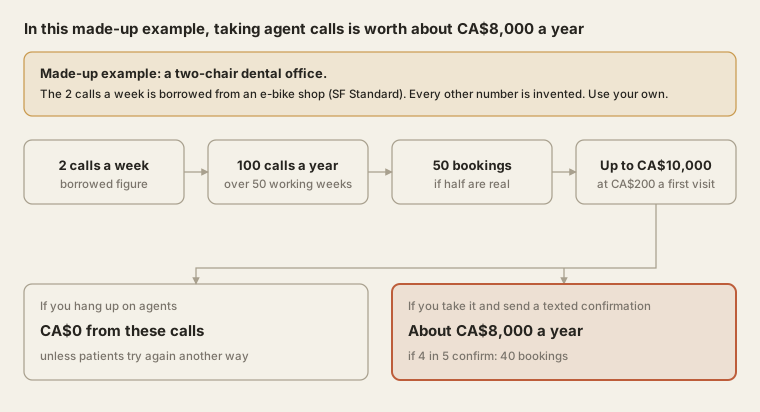
The other ten are patients the text never reaches or who change their minds. In this made-up example, a confirmation step loses some bookings and a hang-up loses all 50.
What if my own phone is answered by AI too?
Voygr found that 1 in 25 of the businesses in its test already had their own AI agent answering calls. Some of these conversations are already bot to bot.
Whatever answers your phone (you, a staff member, an answering service or an AI receptionist) needs the same four rules: identify the caller, collect a human name and number, send payment as a link to that person, and confirm with them directly. Write them down once and every ring gets the same answer.
Do AI callers have to tell you they’re AI in Canada?
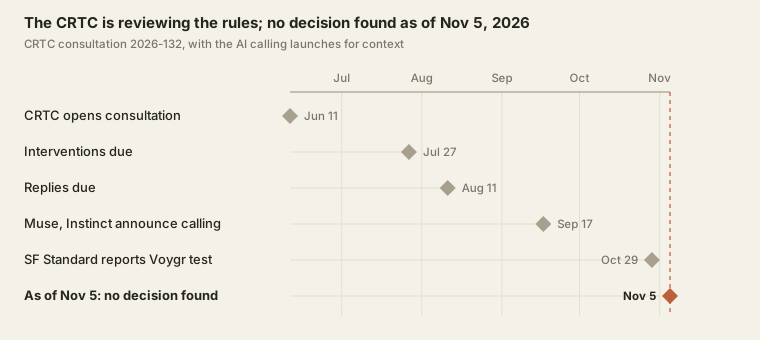
We couldn’t find a Canadian rule that requires it today, and the CRTC is asking the question now. On June 11, 2026, the CRTC opened Compliance and Enforcement Notice of Consultation 2026-132, a review of the Unsolicited Telecommunications Rules. It asks whether telemarketers should have to tell people at the start of a call that they aren’t speaking to a live person. It also asks whether the rules should cover calls made strictly for personal use, and its examples are someone using these tools to book a health care appointment or a restaurant reservation. Interventions were due July 27 and replies August 11, so any new rules will come in a later decision.
That second question is the one that affects you. An agent booking for a consumer may not count as telemarketing at all, and the CRTC hasn’t said yet. Until it rules, your script’s first question, “Which app or service are you calling from?”, gets you the disclosure no regulation guarantees. If you use AI on your own line and are wondering about the other side of this, we covered it in Do I Have to Tell Customers They’re Talking to an AI?
This section is general information, not legal advice. For your situation, consult a qualified lawyer.
The one rule to keep
An agent call is a booking with an extra step, and the extra step is finding the human. Tape the script by the phone, start the tally this week, and look at the number in December. If you’d like to hear an AI receptionist answer a call, you can try ours at zalena.ai.
Sources
- SF Standard, “Press 1 if you’re a robot: AI agents keep calling local businesses,” October 29, 2026.
- Ivan Mehta, TechCrunch, “Rival AI agents, Instinct and Meta’s Muse, both add the ability to make calls,” September 17, 2026.
- AnswerConnect (PR Newswire, paid press release via Yahoo Finance), “AI Backlash Grows Across US, UK, and Canada: More Customers Reject Bots for Human Support in 2026,” May 13, 2026.
- CRTC, Compliance and Enforcement Notice of Consultation CRTC 2026-132, “Call for comments: Review of the Unsolicited Telecommunications Rules,” June 11, 2026.