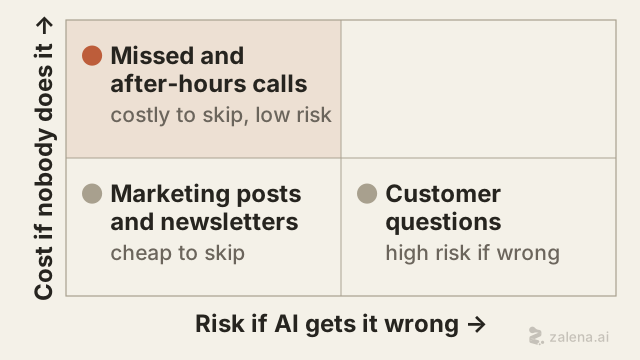
We think many owners give AI their marketing first. Their phones would be a better first job.
Quick answer
If you can’t afford to hire a receptionist, give AI your missed and after-hours calls before your marketing. Owners are wary of letting AI answer customer questions. That caution is fair. Answering the phone is a narrower job. An AI receptionist on intake takes the caller’s details, books a slot you allow and passes anything tricky to you. Mistakes there are cheap. An unanswered call can cost you the job. Test it for 30 days on missed calls only, and count the bookings.
In Canada, more small firms plan to cut staff than to hire. That has held for four months in a row, says the Canadian Federation of Independent Business (CFIB). Meanwhile, two in three US small businesses now use AI tools. That comes from Gusto’s 2026 State of Small Business report.
Picture an owner polishing a newsletter at night with ChatGPT, a popular AI chat tool. During the day, their phone rings out while they’re under a sink or with a client. If that sounds like you, your AI may be doing the wrong job first.
One disclosure first: we build Zalena, an AI receptionist. Weigh our view with that in mind.
Key words in this post
- AI receptionist (artificial intelligence receptionist): software that answers your phone in a natural voice. It takes details and books appointments. Some people call it a virtual receptionist.
- Intake: the first contact with a new customer. Who they are, what they need and when they want it.
- After-hours call: a call that comes in while you’re closed: evenings, weekends and holidays.
- Call forwarding: a phone setting that sends calls to another number. It can send only the calls you don’t answer.
- Transcript: a written, word-for-word record of a call.
Other terms are explained where they first appear. All of them are in the glossary at the end.
Are other small businesses really using AI, or is it hype?
It’s real, but shallow. Gusto surveyed 1,731 owners of US businesses with 24 or fewer employees. Gusto sells payroll software. That makes this vendor research: a survey from a company that sells something related. It is useful, but it may lean their way. CPA Practice Advisor reported the results on 12 November 2026.
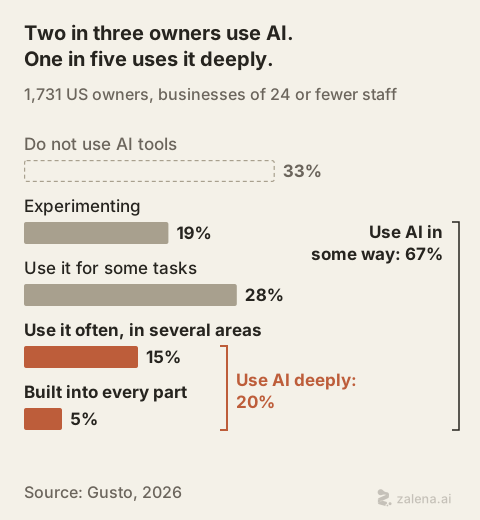
Gusto reports the 67%. The 33% who don’t use AI is what is left. Two thirds of owners use AI in some way. Only one in five uses it often or everywhere. The rest are trying it out, or using it for a few tasks. The write-up doesn’t say which tasks. Its findings on comfort point to communication tasks and marketing drafts.
Is it hard to hire in Canada, or is it just me?
It’s not just you. Hiring plans are weak in Canada and the UK, and slipping in the US.
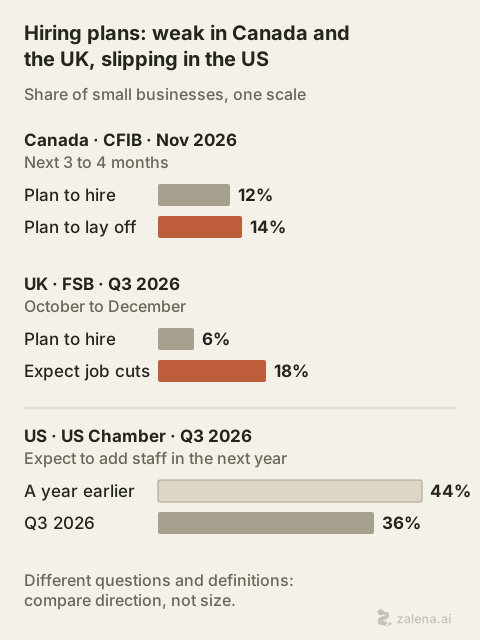
Start with Canada. CFIB asks its members about business every month, in a survey called the Business Barometer. Its November 2026 Business Barometer asked about the next three to four months. In it, 14% of firms planned to lay off full-time staff. Only 12% planned to hire. CFIB says this is the fourth month in a row with more planned layoffs than hires. A shortage of skilled labour held back 40% of firms. Weak demand held back more, at 52%. The survey had 565 responses. Treat the exact figures as approximate.
In the US, Gusto found that 26% of owners tried to hire in the past year and struggled. They couldn’t find qualified people they could afford. Of those, 64% said candidates lacked the skills the job needed. The smallest businesses more often said they couldn’t afford the pay that qualified people wanted.
The US picture is brighter, but slipping. The US Chamber of Commerce polls owners every three months. Q3 is the third quarter of the year, July to September. Its Q3 2026 Small Business Index found 36% of firms expect to add staff in the next year. A year earlier, it was 44%. The research firm Ipsos polled 759 owners, the Chamber’s method page says. It counts firms with up to 500 employees as small. That’s far bigger than a two-van plumber.
In the UK, Startups.co.uk reported the Federation of Small Businesses (FSB) survey for Q3 2026. In those three months, 20% of small firms cut staff. Only 7% added staff. For October to December, 18% expect more job cuts and 6% plan to recruit. That’s three firms planning cuts for each one planning to hire.
What do owners trust AI to do, and what don’t they?
Owners are most comfortable letting AI work with limited checking on communication tasks. They’re far less comfortable giving it data analysis or direct customer questions.
About 60% of owners who use AI are comfortable letting it draft marketing with limited checking. Among owners who don’t use AI, only 27% are. We think owners who try AI grow more comfortable with it. Our guess is that most stay with the jobs where they started.
The worry about customer questions is fair. Picture a bot that guesses at a quote or misreads a symptom. One wrong answer can cost more than it saves. We think many owners respond by keeping AI away from customers entirely. They point it at marketing instead. On our chart below, that is the corner that matters least.
Treat the worry as a design rule instead. AI shouldn’t answer your customers’ hard questions. It can still answer the phone.
Which job should I hand to AI first?
Score each task two ways. What does it cost you when nobody does it? What does it cost you when AI does it badly?
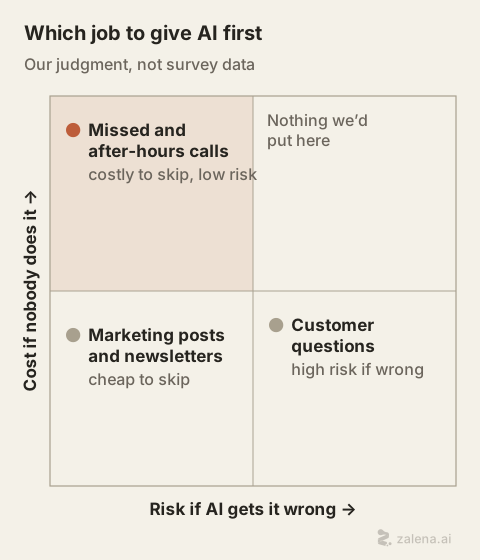
We think the top-left corner is the one owners most often skip. A missed call rarely waits for you to call back. The caller may be working down a list of search results.
Moneypenny surveyed 2,000 consumers and 500 trade firms. Moneypenny sells answering services, by people and by AI. Contracting Business reported it in May 2026. In that survey, 83% of US consumers said they choose the business that responds first. Treat the exact number with care, given who paid for it. Your own call log is better evidence. That’s the list of calls your phone or phone company keeps. Check how many missed numbers never called back.
We covered what missed calls cost in the real cost of missed calls for small businesses.
That makes intake the first job. In practice, intake means four things:
- Answer the calls you would otherwise miss.
- Find out who is calling and what they need.
- Book into the time slots you allow.
- Pass anything that needs judgment to you.
How do I keep AI from saying the wrong thing to a customer?
Narrow the job, then check the work. Here is a setup we’d be comfortable with.
- Script the greeting. Write the first two sentences yourself, with your business name in them.
- Limit what it can do. Booking, taking messages and answering your FAQs. Nothing else. FAQs (frequently asked questions) are the common questions you write answers to in advance.
- Rule things out. No prices beyond your published rates. No diagnoses. No legal or medical opinions. The answer to all of these is “I’ll have the owner call you back.”
- Send urgent calls to your cell. Decide what “urgent” means in your trade: a burst pipe, a client in custody, a patient in pain.
- Get a record of each call. A summary or transcript. If you can’t see what was said, you’re not in charge of it.
- Read each call for the first two weeks. You’ll find the gaps in your FAQs quickly.
Whether to tell callers they’re speaking with AI depends on where you work. We covered it in our post on telling customers they’re talking to an AI. This isn’t legal advice.
What does this cost compared with a part-time hire or an answering service?
A part-time hire isn’t the only option for phone answering in a small business.
| Option | How you pay | Hours covered | Who makes the judgment calls |
|---|---|---|---|
| Part-time receptionist | Wages, plus payroll costs: the taxes and benefits an employer pays on top. About CA$2,167 a month in our made-up example below. | Only the hours you pay for | The receptionist, and you |
| Human answering service | Usually per call or per minute. The bill rises in busy months. | Depends on the provider. Some keep live staff on at night and on weekends. | Trained staff following your script, and you |
| Voicemail | Free with most phone plans | All hours, but nobody answers | You, if the caller leaves a message |
| AI on intake | Usually a monthly plan with included minutes or calls, plus extra use | Whenever you switch it on, after hours included | You. The AI passes those calls to you. |
For more detail, see AI receptionist vs answering service vs voicemail.
Every number in this example is made up. We use Canadian dollars (CA$). The sums work the same in US dollars, pounds or euros.
Made-up example: a two-van plumbing business
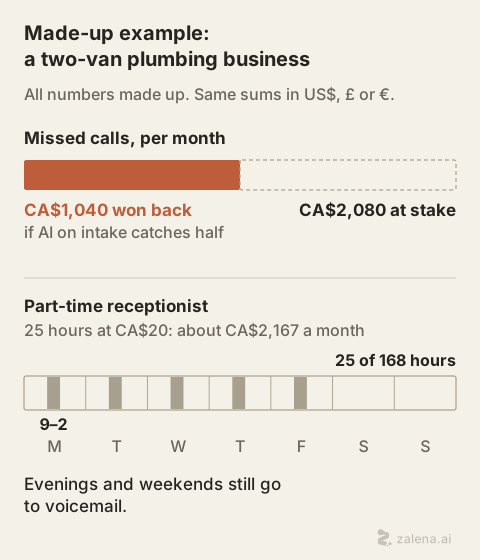
A part-time hire covers 25 of the week’s 168 hours. Evenings and weekends still go to voicemail. The table holds the guesses behind the chart. Swap in your own.
| Assumption | Our made-up number | Result |
|---|---|---|
| Missed calls a week (on jobs, after hours, weekends) | 8 | 8 calls |
| Share that are new-job inquiries | 40% | 8 × 0.4 = 3.2 inquiries |
| Share of those that would book if answered | Half | 3.2 × 0.5 = 1.6 jobs |
| Average job value | CA$300 | 1.6 × CA$300 = CA$480 a week |
| Per month | 52 weeks ÷ 12 months | CA$480 × 52 ÷ 12 = CA$2,080 at stake |
| AI wins back | Half | CA$2,080 × 0.5 = CA$1,040 a month |
| Part-time hire | 25 hours × CA$20 | CA$500 a week, about CA$2,167 a month |
AI on intake takes the calls that come in while you’re busy, and the after-hours calls. A receptionist would also catch some missed calls, the daytime ones. The hire costs about CA$2,167 a month and still misses evenings and weekends. AI on intake answers whenever you switch it on. You still make the judgment calls.
Our post on AI receptionist cost per call turns any quote into a price per call. Multiply that by your calls each month. Set the total against the hire and against your own version of the CA$1,040. Our cost calculator runs a normal and a busy month side by side. Our own prices are at zalena.ai/pricing, in Canadian dollars.
One warning. If most of your missed calls are existing customers asking about invoices, the sums change. Know that before you spend anything.
How do I test this without betting the business on it?
Run it for 30 days, and keep it narrow.
- Before you start: count the calls you miss in a normal week, and the bookings that come from them.
- Days 1 to 30: forward only missed and after-hours calls to the AI. Leave your daytime phones exactly as they are.
- Day 30: compare bookings from forwarded calls with your count. Read the transcripts for anything you’d have handled differently.
If bookings don’t rise, you’ve paid one month’s fees. You also know your call pattern better.
Want to hear an AI receptionist take a call? You can call ours from zalena.ai.
Frequently asked questions
Should a small business use AI for marketing or for answering calls first?
Calls first, if you are short-staffed. Give AI your missed and after-hours calls. Keep its job narrow: take details, book slots you allow and pass anything tricky to you. A missed call can lose a job. A narrow intake job leaves AI little room to go wrong. A rough marketing draft costs little, because you read it before it goes out.
Can an AI receptionist replace a part-time receptionist?
Not fully. It can cover the calls a part-time hire would miss. Think of evenings, weekends and calls while you are on a job. It should not quote prices beyond your published rates, diagnose problems or give advice. Those calls should come back to you.
Is it hard for Canadian small businesses to hire in 2026?
Hiring plans are weak. CFIB’s November 2026 Business Barometer asked about the next three to four months. In it, 14% of small businesses planned to lay off full-time staff. Only 12% planned to hire. It was the fourth month in a row with more planned layoffs than hires. A shortage of skilled labour held back 40% of firms.
Is there an affordable after-hours answering service in Canada?
There are three common options. A human answering service has trained staff take your calls, usually for a fee per call or per minute. Voicemail is free, but nobody answers. An AI receptionist on intake answers, takes details and books, usually for a monthly plan. Compare them on what you pay in a busy month and who handles the hard calls. Our comparison post covers the trade-offs. Our own prices are on our pricing page, in Canadian dollars.
How do I test an AI receptionist without risking my business?
Run it for 30 days on missed and after-hours calls only. Leave your daytime phones as they are. Before you start, count your missed calls and bookings for a normal week. At the end, compare bookings and read the call transcripts.
Part of our series on small business phone strategy. Browse all posts.
Glossary
- After-hours call: a call that comes in while you’re closed: evenings, weekends and holidays.
- AI receptionist (artificial intelligence receptionist): software that answers your phone in a natural voice. It takes details and books appointments. Some people call it a virtual receptionist.
- Answering service: a company whose staff answer your phone for you, following your script. Usually paid per call or per minute.
- Business Barometer: CFIB’s monthly survey of its members about how business is going and what they plan.
- Call forwarding: a phone setting that sends calls to another number. It can send only the calls you don’t answer.
- Call log: the list of calls your phone or phone company keeps, missed calls included.
- CFIB (Canadian Federation of Independent Business): a Canadian group that speaks for small and medium-sized businesses.
- ChatGPT: a popular AI chat tool. You type a question or a task, and it writes a reply.
- FAQ (frequently asked questions): the common questions you write answers to in advance.
- FSB (Federation of Small Businesses): a UK group that speaks for small businesses.
- Intake: the first contact with a new customer. Who they are, what they need and when they want it.
- Ipsos: a market research firm. It ran the US Chamber of Commerce’s poll.
- Made-up example: numbers we chose to show how the sums work. They are not measured.
- Payroll costs: what an employer pays on top of wages, such as payroll taxes and benefits.
- Q3: the third quarter of the year, July to September.
- Small business: the surveys here define it differently. Gusto counts businesses with 24 or fewer employees. The US Chamber counts up to 500.
- Transcript: a written, word-for-word record of a call.
- Vendor research: a survey from a company that sells something related. Useful, but it may lean their way.
- Voicemail: a recorded message the caller leaves when nobody answers.
Sources
- Canadian Federation of Independent Business, “Monthly Business Barometer,” November 2026 results, 19 November 2026. 565 responses from CFIB members, 3 to 9 November 2026; margin of error plus or minus 4.1 points, 19 times in 20.
- Isaac M. O’Bannon, “Small Business Owners Are More Confident in Their Own Companies Than in the Economy, and Two-Thirds Use AI,” CPA Practice Advisor, 12 November 2026. Reports Gusto’s 2026 State of Small Business report: 1,731 owners of US businesses with 24 or fewer employees (vendor research; Gusto sells payroll software).
- US Chamber of Commerce, “Executive Summary,” Justworks and US Chamber of Commerce Small Business Index, Q3 2026, 30 September 2026. Ipsos poll of 759 small business owners and operators, 4 to 18 August 2026; small means 500 or fewer employees.
- US Chamber of Commerce, “Survey Methodology,” Small Business Index, Q3 2026. Ipsos, 759 owners and operators, 4 to 18 August 2026; companies with 500 or fewer employees that are not sole proprietorships.
- Isobel O’Sullivan, “Over half of UK small businesses are losing revenue. Will the Budget deliver relief?,” Startups.co.uk, 26 October 2026. Reports the FSB Small Business Index for Q3 2026.
- “Fast Response Times Drive Home Services Customer Loyalty, Survey Shows,” Contracting Business, 29 May 2026. Reports a Moneypenny survey of 2,000 consumers and 500 construction and trade firms (vendor research).
- Moneypenny, “US answering service” home page: live virtual receptionists and AI that answer calls and chats (read 19 November 2026).