Can a Chatbot Legally Commit Your Business? The Air Canada Case Explained
A tribunal held Air Canada liable when its chatbot invented a policy. Here is what Moffatt v. Air Canada means for small businesses, and how to stay safe.
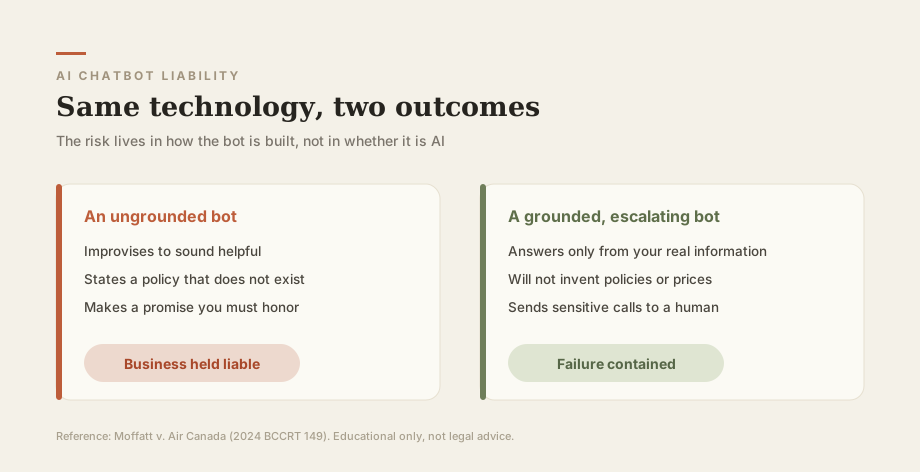
A real ruling made business owners nervous about AI. Here is what actually happened, and how to make that failure mode nearly impossible.
This article is general information, not legal advice. For your situation, consult a qualified lawyer.
Quick answer: Yes, a business can be held responsible for what its chatbot says. In Moffatt v. Air Canada (2024 BCCRT 149), a tribunal found Air Canada liable after its website chatbot described a refund policy that did not exist, and rejected the airline's argument that the chatbot was a separate legal entity. Damages were small (about CA$650), but the precedent is large. "The bot said it, not us" is not a defense. The fix is not to avoid AI. It is to use an assistant that cannot invent answers.
What actually happened in the Air Canada case?
In November 2022, Jake Moffatt asked Air Canada's website chatbot about bereavement fares. The bot told him he could book and apply for a reduced rate retroactively, which contradicted Air Canada's real policy. When his refund was denied, he took it to British Columbia's Civil Resolution Tribunal. The tribunal member found Air Canada's claim that the chatbot was responsible for its own actions to be "a remarkable submission," noting the chatbot "is still just a part of Air Canada's website." The airline was ordered to pay CA$650.88 in damages (about CA$812 with interest and fees).
Why does this worry small businesses more than big ones?
A multinational can absorb a bad promise and a bruising news cycle. A small business often cannot. When you are your reputation in a local market or a niche online category, one invented policy you have to honor, or publicly walk back, does outsized damage. The caution is rational. The mistake is concluding that the answer is to avoid AI entirely.
What was the real cause, the AI or how it was built?
The cause was a bot left free to improvise: to produce a confident, plausible answer with no grounding in the company's actual policies. That is a design choice, and it is avoidable.
How do you make this failure mode nearly impossible?
A safer assistant is built to do the opposite of freelancing:
- It answers only from your own information, and when it does not know, it says so instead of inventing.
- It will not quote prices, terms, or policies it cannot verify, the exact mistake that put Air Canada in front of a tribunal.
- It escalates anything sensitive, unusual, or legally consequential to a human before it becomes a promise.
- It keeps a record of what was said, so nothing happens in the dark.
That is the principle behind Zalena: grounded in the information you give it, built to hand off when a call needs judgment. The point is not that mistakes become impossible. It is that the specific failure that sank Air Canada is engineered out.
A short checklist before you turn any bot loose
Is it grounded (answers only from your information)? Does it admit what it does not know? Can it quote prices or policies it cannot verify (it should not)? Does it escalate sensitive calls cleanly? Is there a record? A bot that clears these is not a liability waiting to happen. It is a tool with guardrails.
Which industries carry the most chatbot liability risk?
Anywhere a wrong answer creates a financial or legal obligation:
- Online retail and ecommerce: returns, shipping timelines, authenticity, discount claims.
- Travel, hospitality, and events: fares, cancellations, refund rules (the Air Canada scenario itself).
- Insurance and financial services: coverage, eligibility, and pricing statements.
- Healthcare, dental, and clinics: anything edging toward medical advice.
- Real estate and property management: availability, terms, disclosures.
- Automotive sales and service: quotes, warranties, trade in promises.
Case study: Walee Fragrance, Markham (perfume ecommerce)
Walee Fragrance Company is a Shopify based perfume and attar retailer in Markham that ships across Canada and internationally, with both a storefront and a customer line. An online store fields a constant stream of questions across time zones: "Is this alcohol free?", "When will my order arrive?", "What is your return policy?", "Is this genuine?" Answered wrong, those are not just unhappy customers. A bot that invents a shipping window or a return rule can create exactly the kind of obligation the Air Canada ruling warns about.
Walee's Zalena assistant answers only from Walee's real product data and policies, across chat, WhatsApp, Instagram, and SMS, around the clock. It confirms what it knows (ingredients, sizes, published shipping and return terms) and refuses to improvise on anything it cannot verify, routing edge cases to a person. The result is faster answers for international shoppers at 2 a.m., and a customer facing assistant that does not make promises Walee cannot keep.
FAQ
Can a company be held liable for what its chatbot says? Yes. In Moffatt v. Air Canada (2024), a tribunal held the company responsible for inaccurate information its chatbot provided, and rejected the idea that the chatbot was a separate entity.
How much did Air Canada have to pay? About CA$650.88 in damages, with the total award near CA$812 including interest and fees. The financial hit was small. The precedent is the real takeaway.
Should small businesses avoid AI chatbots because of this? No. Use a chatbot that answers only from your verified information, will not invent policies, and escalates sensitive questions to a person.
What makes an AI assistant safe for customer service? Grounded answers (no guessing), no unverifiable promises, clear human escalation, and a record of interactions.
Part of our series on small business phone strategy. Start with the overview, Press 1 for English: What My Insurance Company Taught Me About AI.
Sources
- Moffatt v. Air Canada, 2024 BCCRT 149 (Civil Resolution Tribunal of British Columbia).
- CBC News, coverage of the ruling: https://www.cbc.ca/news/canada/british-columbia/air-canada-chatbot-lawsuit-1.7116416
- American Bar Association, Business Law Today, analysis of company liability for chatbot information: https://www.americanbar.org/groups/business_law/resources/business-law-today/2024-february/bc-tribunal-confirms-companies-remain-liable-information-provided-ai-chatbot/
Get new posts in your inbox
Notes on AI assistants, customer experience, and what's working for the small businesses building on Zalena. No spam.