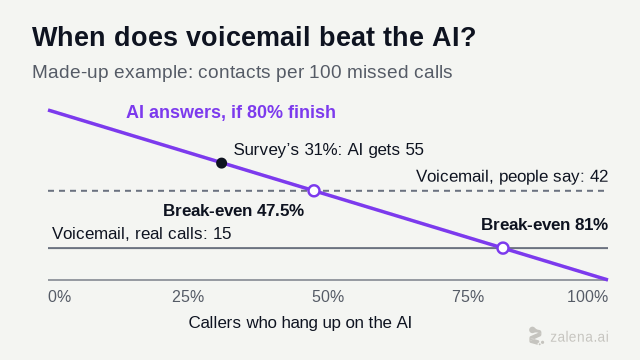
Two surveys disagree about AI on the phone. For the calls you miss, compare it with voicemail instead.
Quick answer
Yes, some callers hang up on an AI receptionist. In one survey, 31 per cent said they would. But for calls you miss, the AI is not up against a person. It is up against voicemail. Call records say only 15 per cent of callers leave a voicemail. With our assumptions, the AI could lose 81 per cent of callers and still match it.
“Customers hate talking to a bot. They’ll just hang up.” This month, you could find a headline to back either side.
A press release came out on 19 November. It said 55 per cent of people are less likely to become a customer when a bot answers. Four days later, a trade site said about 7 in 10 would take a voice AI over waiting. Each answers a fair question. Neither asks about the owner who is out on a job when the phone rings.
One disclosure first: we build Zalena, an AI receptionist. Weigh our view with that in mind.
Key words in this post
- AI receptionist (artificial intelligence receptionist): software that answers your phone in a natural voice and takes details.
- Hang-up rate: the share of callers who end the call in the first seconds.
- Voicemail rate: the share of missed callers who leave a message.
- Completion rate: of the callers who stay on the line, the share who give a name, number and reason.
- Break-even hang-up rate: the hang-up rate at which the AI captures no more callers than voicemail.
- Stated versus measured: what people say they would do, against what records show they did.
Other terms are explained where they first appear. All of them are in the glossary at the end.
Who’s who in this post
Seven companies supply the numbers below. Most of them sell something to do with phone calls.
| Company | Sells | Its survey or data |
|---|---|---|
| AnswerConnect | Live human answering | 6,000 adults in Canada, the US and UK, 2026 |
| PolyAI | Voice AI agents for large companies | 1,000+ US consumers, reported November 2026 |
| Five9 | Contact-centre software | 3,000 consumers in the US, UK and Germany, 2026 |
| Quo | A business phone system, plus an AI receptionist | 18 million+ missed calls, 2026 |
| CallRail | Call tracking, plus an AI that answers calls | 1,000 US consumers, 2025 |
| Upfirst | AI receptionists | 450,702 calls to 503 AI receptionists, 2026 |
| Hiya | Spam-call protection and branded caller ID for businesses | 12,000+ consumers in 6 countries, including Canada, 2026 |
Two surveys, two different comparisons
The gloomy numbers come from a survey paid for by AnswerConnect, which sells live human answering. A polling firm called OnePoll ran it. The survey covered 6,000 adults, split evenly across the US, the UK and Canada. AnswerConnect says it ran the survey in May 2026. The same figures were first published in May. AnswerConnect put them out again on 19 November. No Canada-only figures were published.
The 31 per cent was up from 29 per cent in an earlier round of the same survey. Our post on telling callers they are talking to an AI covers more of its findings.
The hopeful number comes from PolyAI. CX Dive reported on 23 November on PolyAI’s survey of more than 1,000 US consumers. People were asked about using a voice AI instead of waiting for a human. There was one condition: the AI had to guarantee no wait. The article’s examples were tracking orders and changing flights. We read that as big companies with long hold queues, not a local cleaner.
| Survey | AI was compared with | Headline |
|---|---|---|
| AnswerConnect | A person picking up | 31% would hang up |
| PolyAI | Waiting on hold | About 7 in 10 would use the AI |
Each survey set up the choice in a way that suits its sponsor. Both also measured what people say, not what they do.
For missed calls, the AI is up against voicemail
Without a receptionist, you answer a call or it goes to voicemail. Some owners pay a service to pick up instead.
The “person versus AI” finding only covers calls a person would have answered. For the calls you miss, the rival is your voicemail greeting. Neither survey measured that.
Quo looked at more than 18 million missed calls on its phone system, from July to September 2026. Only 15 per cent ended in a voicemail. Quo also sells an AI receptionist, which gives it a stake in a low number.
| Left a voicemail | Share |
|---|---|
| People say (CallRail survey) | 42% |
| All missed calls (Quo records) | 15% |
| After hours (Quo) | 14% |
| Home services (Quo) | 16% |
In surveys, people say they leave messages nearly three times as often as call records show. The 31 per cent hang-up figure is a stated number too. If stated voicemail runs this high, stated hang-ups may as well.
The break-even hang-up rate
How bad would the AI have to be before voicemail beats it?
Start with 100 missed calls. Voicemail on real calls catches about 15 callers. With the AI, some callers hang up at once. Of those who stay, we assume 80 per cent finish the call with a name, number and reason. That 80 per cent is our guess, not a measured figure. A contact is a caller whose name, number and reason you now have.
The break-even rule fits on one line. Divide the voicemail rate by the completion rate, then take the answer from one.
- Against voicemail on real calls, 15 per cent: 1 − (15 ÷ 80) = about 81 per cent.
- Against what people say, 42 per cent: 1 − (42 ÷ 80) = 47.5 per cent.

Where the AI line crosses a flat line, voicemail starts to win. At the survey’s 31 per cent hang-up rate, the AI is still well above both.
A weaker AI drags the break-even down. The table shows how far.
| AI completion | Against real voicemail (15%) | Against stated voicemail (42%) |
|---|---|---|
| 90% finish | 83% | 53% |
| 80% finish (chart) | 81% | 47.5% |
| 70% finish | 79% | 40% |
| 60% finish | 75% | 30% (under the survey’s 31%) |
Voicemail wins in only one cell, and only just. It takes a weak AI and the voicemail rate people claim, not the one records show.
A made-up example: a cleaner in Ottawa
These numbers are made up, not a client’s. A home cleaning company in Ottawa has an owner and two crews. It gets 120 calls a month. The owner answers 70. The other 50 come while she is on a job or after hours.
Fifty is half of 100, which means every figure in the chart halves. These are monthly averages, which is why some have decimals. We use the survey’s 31 per cent hang-up rate and our 80 per cent completion. With the AI, 15.5 of the 50 callers hang up. The other 34.5 stay. One in five of them, 6.9, do not finish. The other 27.6 leave their details. With voicemail, 15 per cent of the 50 leave a message, or 7.5.
| The 50 missed calls | Voicemail | AI answers |
|---|---|---|
| Hang up or leave no message | 42.5 | 15.5 |
| Stay but do not finish | None | 6.9 |
| Contacts captured | 7.5 | 27.6 |
The AI brings in about 20 extra contacts a month, even with the gloomy survey’s hang-up figure. Say one in four books a first clean at CA$220. Five jobs make CA$1,100 a month. Like the rest of the example, those two numbers are made up.
Now the cost, on our own plan. Zalena’s Answer plan costs CA$49 a month plus tax, as listed on 26 November 2026. It includes 150 voice minutes. Calls under 15 seconds are not counted, which means quick hang-ups cost nothing. We guess each caller who stays talks for three minutes.
| The month, before tax | Amount |
|---|---|
| Callers who stay on the line | 34.5 |
| Minutes used (3 each, our guess) | About 104 of 150 |
| Cost per contact (27.6) | About CA$1.78 |
| Cost per extra contact (20.1) | About CA$2.44 |
Our cost-per-call post compares prices in more detail.
Keep the AI off the calls she already answers. On those 70 calls, 31 per cent is about 22 callers. Those callers reach a person today.
What real AI calls show
Upfirst, which sells AI receptionists, counted hang-ups on real calls, not survey answers. It studied 450,702 calls to 503 AI receptionists. It did not publish one overall hang-up rate.
Upfirst counted a hang-up as a call under 15 seconds, or one where the caller never spoke. About 8 in 10 of those short calls were silent. We suspect some are robocalls (automated calls from machines) or wrong numbers. Voicemail would lose those too.
Upfirst reports its results as odds. Odds compare callers who hang up with callers who stay. Higher odds mean more hang-ups.
| Setting | What Upfirst found |
|---|---|
| Saying it is an AI | About 20% lower hang-ups |
| “Sorry, we can’t take your call” opening | Roughly 50% higher hang-up odds |
The two rows use Upfirst’s own words. Its method measures every setting as odds, even where its summary says “lower hang-ups”. Settings like these explain only about one-eighth of why some businesses get more hang-ups than others. Upfirst says these are links, not proof of cause.
Disclosure, meaning telling callers it is an AI, has mixed evidence elsewhere. Yuqian Xu at UNC studied a freight platform’s voice bot. It rang more than 10,000 truck drivers to offer them work. When the bot said it was a bot, response fell by 11 per cent. Those drivers did not ask for the call. A caller to your business does want something done. We think that changes how people react.
Which calls suit an AI?
Acceptance depends on the task more than on the technology. Five9, which sells contact-centre software, ran a survey of 3,000 consumers in the US, UK and Germany. Hanover Research, a market research firm, ran it online in April 2026. The figures below come from CMSWire, a trade site for customer-experience teams. Five9’s full report sits behind a sign-up form.
| Your kind of call | Say AI can do it alone | Closest Five9 task |
|---|---|---|
| Hours, address, service area | 38% | Password reset |
| Booking, rescheduling, quote request | 35% | Order or account status |
| Billing dispute | 15% | Refund |
| Emergency or upset caller | 10% | High-stakes problem |
We matched each Five9 task to a small-business call (left column). Simple calls suit the AI. Complaints, money disputes and emergencies belong with a person.
Setup that keeps callers on the line
Don’t make the AI sound like your voicemail. Skip “Sorry, nobody can take your call.” That kind of opening was the biggest harm Upfirst found among settings an owner controls. Open with the business name and what the caller can get done now.
Say it is an AI in the first sentence. In the Five9 survey, 71 per cent said this matters a lot to them. Our disclosure post has a sample greeting.
Offer a person early. In the same survey, 92 per cent give an AI less than 10 minutes. After that, they want a person. Offer a transfer, or promise a call-back by a set time. For urgent calls, ask your provider whether it can alert you by text.
Don’t make callers repeat themselves. Pass what the AI hears to whoever calls back.
Call back from a number that shows your name. Hiya surveyed Canadians in 2026. It sells branded caller ID, which shows your business name on the screen. Only 12 per cent immediately answer a call from an unknown number. And 34 per cent are most likely to answer when a verified business name shows. A call-back from a bare cell number may go unanswered.
Measure for 30 days. Track three numbers: calls the AI answered, silent or short hang-ups, and contacts captured. Compare the last one with last month’s voicemail count. That gives you your own hang-up rate, from your own calls.
We found no Canadian study that measures AI hang-ups on real calls. Until one appears, your own phone log is the best evidence.
If a human answering service fits your budget, it wins on judgement for hard calls. A mix works too. You keep the calls you answer, and the AI takes the overflow and after-hours calls.
Call +1 (437) 524-1147 to hear how an AI greeting sounds before you decide. It is the demo number on the zalena.ai home page.
Frequently asked questions
Do callers hang up on an AI receptionist?
Some say they would. AnswerConnect surveyed 6,000 adults in Canada, the US and the UK. It says it ran the survey in May 2026. Of them, 31 per cent said they would hang up on an AI. That is what people said, not what they did on real calls. AnswerConnect sells live human answering.
What percentage of callers leave a voicemail?
About 15 per cent, in the one large, recent measure we found. Quo, a business phone company, looked at more than 18 million missed calls. They came from July to September 2026. Only 15 per cent ended in a voicemail. In a separate survey, 42 per cent of people said they leave one.
How high would the hang-up rate have to be before voicemail does better?
Very high. Divide your voicemail rate by the share of callers who stay on the line and then finish the call. Then take that from one. Say 15 per cent leave a voicemail and 80 per cent of those who stay finish. Then the AI loses only if more than 81 per cent hang up. The 80 per cent is our guess. Test it on your own calls.
Does saying it is an AI make callers hang up more?
On calls into a business, one large vendor study points the other way. Upfirst, which sells AI receptionists, studied 450,702 calls. Saying it was an AI was linked to about 20 per cent fewer hang-ups. A study where a bot rang truck drivers about work found the opposite. We think the direction of the call matters.
Part of our series on small business phone strategy. Browse all posts.
Glossary
- AI receptionist (artificial intelligence receptionist): software that answers your phone in a natural voice and takes details. Some plans also book appointments.
- Answering service: a company whose staff answer your phone for you, following your script.
- Branded caller ID: a service that shows your business name on the screen of the person you call.
- Break-even hang-up rate: the hang-up rate at which the AI captures no more callers than voicemail. Work it out as 1 − (voicemail rate ÷ completion rate).
- Call tracking: software that shows which ad or web page made your phone ring.
- Completion rate: of the callers who stay on the line, the share who give a name, number and reason.
- Contact: a caller whose name, number and reason you now have.
- Contact centre: a large team, often helped by software, that handles a company’s customer calls and messages.
- Disclosure: telling callers they are talking to an AI.
- Fielded: the dates a survey was actually run, not when it was published.
- Hang-up rate: the share of callers who end the call in the first seconds. Upfirst counts calls under 15 seconds or with no words.
- Made-up example: numbers we chose to show how the sums work. They are not measured.
- Measured: taken from records of what really happened, such as call logs.
- Missed call: a call nobody picked up.
- Odds: a way to compare callers who hang up with callers who stay. Higher odds mean more hang-ups.
- Robocall: an automated call made by a machine, not a person.
- Stated: what people say they would do in a survey.
- Stated versus measured: what people say they would do, against what records show they did.
- Voice minutes: the minutes of phone calls a plan includes each month.
- Voicemail rate: the share of missed callers who leave a message.
Sources
- AnswerConnect, “The hidden cost of AI on the phone: 55% of consumers less likely to buy when a bot answers,” PR Newswire, 19 November 2026. OnePoll survey of 6,000 adults in the US, UK and Canada; AnswerConnect says it ran in May 2026. The same figures were first reported in Business Journal Daily, “Report: Backlash Grows Against AI in Customer Service,” 15 May 2026. AnswerConnect sells live human answering.
- Bryan Wassel, “Consumers dread long customer service calls during the holidays,” CX Dive, 23 November 2026. PolyAI survey of more than 1,000 US consumers; no fielding dates given.
- Cierra Loflin, “Why only 15% of callers leave a voicemail,” Quo, 2 November 2026. More than 18 million missed calls on Quo, July to September 2026.
- Danielle Wood, “Why businesses can’t afford to miss calls,” CallRail, 25 September 2025. Survey of 1,000 US consumers.
- Alfredo Salkeld, “What makes people hang up on AI receptionists? We analyzed 450,000 calls,” Upfirst, last updated 16 June 2026. 450,702 inbound calls to 503 AI receptionists; observational.
- UNC Kenan-Flagler Business School, “Making voice chatbots more effective by design,” 15 September 2023. Write-up of Yuqian Xu’s field experiment with truck drivers on a freight platform.
- Kenan Institute of Private Enterprise, “Chatbots in Logistics: A Field Experiment on Intelligent Freight Dispatching,” 21 December 2022. Says over 10,000 truck drivers were assigned to receive outbound calls from the voice chatbot.
- Dom Nicastro, “Contact center leaders: you have about 10 minutes before customers give up on AI,” CMSWire, 14 October 2026. Five9 2026 Consumer CX Report: 3,000 consumers in the US, UK and Germany, fielded online in April 2026 by Hanover Research.
- Lena Prickett, “Survey: Canadian businesses losing revenue due to unanswered calls,” Hiya, 5 August 2026. State of the Call 2026: 12,000+ consumers and 3,600 business professionals in 6 countries, including Canada.
- Zalena, “Pricing,” as listed on 26 November 2026. In Canadian dollars, plus tax.